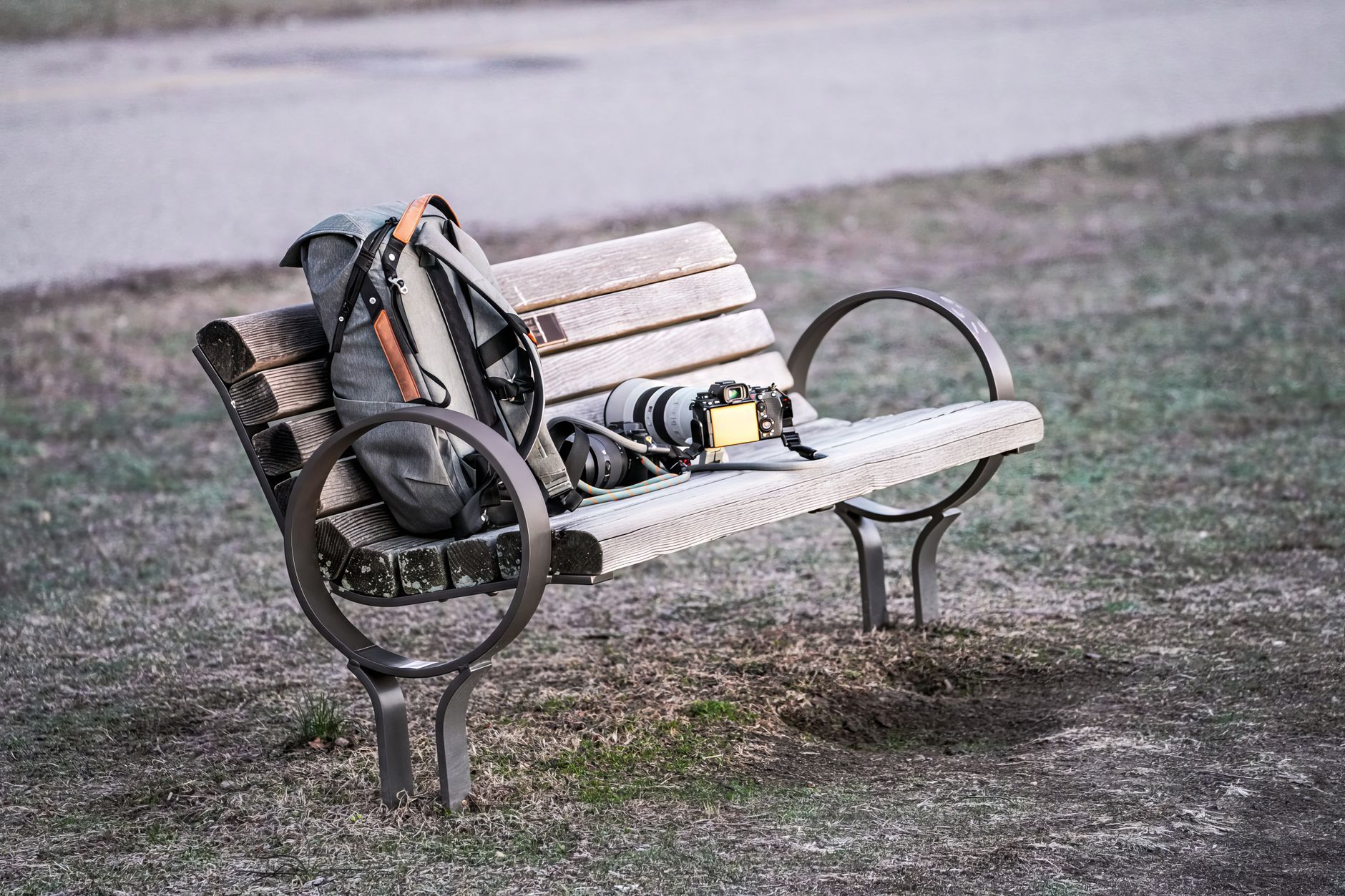
What is the best camera bag for photographers in 2026?
Quick answer: The best camera bag depends on your shooting style: the WANDRD PRVKE is a top choice for travel photographers, the Peak Design Everyday Backpack suits everyday carry, and a sling like the Peak Design Everyday Sling works best for street photographers who need fast access. Prioritize protection, access speed, comfort, and low-key stealth when evaluating any option.
Researched and compared: the best camera bags for travel, street, wildlife, and everyday use. See top picks, a scoring rubric, and a full comparison table.
Key Takeaways
- No single bag is best for everyone. Match the form factor to your shooting style and gear loadout.
- Evaluate every bag on four criteria: protection, access, comfort, and stealth.
- Most camera bags are weather-resistant, not waterproof. Always check for an included rain cover.
- Travel photographers should verify carry-on dimensions against airline limits before buying.
- Backpacks suit heavy kits. Slings and totes work better for minimal, fast-access setups.
- Price ranges vary widely. Entry-level bags start around $50–$80, premium options exceed $300.
- Lifetime warranties from brands like Peak Design and WANDRD add long-term value worth factoring in.
Here's the reality: most photographers overspend on their first bag because they shop by brand hype instead of by use case. This guide fixes that. We've grouped picks by how you actually shoot (travel, street, wildlife, everyday, pro, budget) across all major form factors: backpacks, slings, messengers, totes, and rolling cases. Every pick is scored against the same four criteria so you can shortlist in minutes instead of hours. Pricing and specs are pulled from official manufacturer pages at time of writing and may change, so verify before you buy.
What Makes a Great Camera Bag? Our Evaluation Criteria
A great camera bag protects your gear, lets you access it quickly, carries comfortably when loaded, and doesn't advertise what's inside. Every bag in this guide is evaluated against four criteria:
- Protection — padded dividers, rigid structure, and durable outer fabric
- Access — how fast and how securely you can reach your camera
- Comfort — strap design, back panel ventilation, and load distribution
- Stealth — understated looks that don't scream "expensive camera gear inside"
Tip — How We Evaluated These Bags > Picks in this guide reflect structured research, not physical hands-on testing by Photography Launchpad. Specs and pricing were pulled from official manufacturer pages (Peak Design, WANDRD, Nomatic, and others), cross-referenced with independent reviewers like DPReview, PetaPixel, and Carryology, and triangulated with widely reported photographer consensus from forums and community reviews. This methodology supports transparency without implying field use.
Protection
Protection is the foundation. Nothing else matters if your sensor cracks on a drop.
- Padded dividers and camera cube compatibility protect bodies and lenses from impact
- Higher-denier fabric (600D or above) resists abrasion and extends bag lifespan
- Rigid back panels add structure and shield gear from accidental drops
- Customizable interior dividers let you fit gear-specific layouts instead of forcing standard slots
Access
How you get to your camera matters as much as how well it's protected. A bag you can't shoot out of is a bag that misses moments.
- Side-zip quick-access panels let you grab the camera without removing the bag
- Top-loading designs are secure but slower for active shooting
- Back-panel access keeps zippers against your body in crowded areas, adding security
- Slings offer the fastest single-point access for minimal kits
Comfort
Comfort is where cheap bags fall apart. A hot spot on a strap at hour six of a travel day is a bag you'll resent forever.
- Padded, adjustable shoulder straps reduce fatigue on long shoots
- Ventilated back panels with airflow channels matter on hikes and outdoor sessions
- Sternum straps and hip belts redistribute weight for heavier loads
- Match total loaded weight to form factor. A heavy kit in a sling is a shoulder injury waiting to happen.
Stealth
Stealth is underrated. Bags that look like camera bags invite theft. Independent carry publications like Carryology regularly flag this as a top consideration for urban and travel shooters.
- Understated designs reduce theft risk in cities, airports, and transit
- Muted colorways and minimal external branding blend better on the street
- Back-panel access inherently adds stealth because gear isn't visible when the bag is worn
- Avoid bags plastered with camera-branded logos when shooting in high-risk areas
Best Camera Bags at a Glance: Comparison Table
If you want to shortlist in 30 seconds, this is your table. Full reviews follow below.
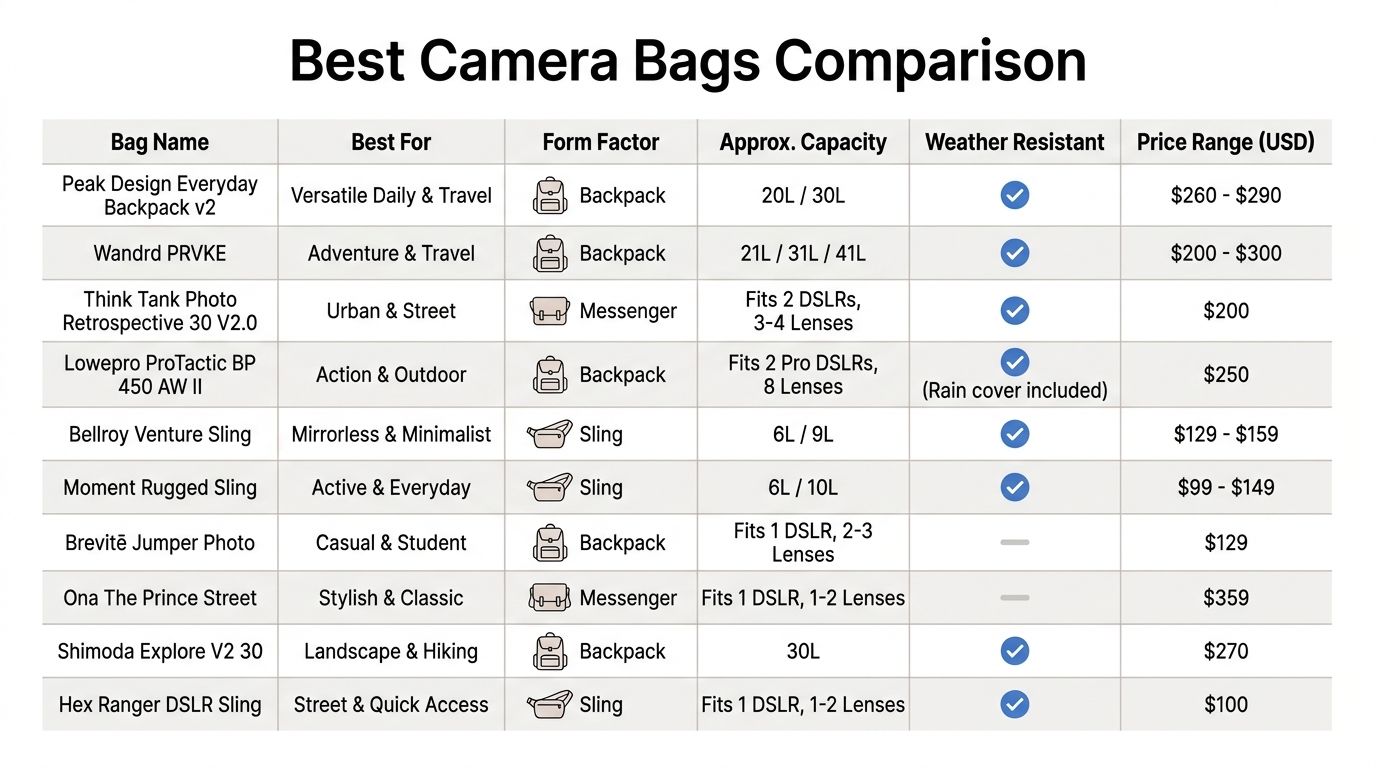
| Bag Name | Best For | Form Factor | Approx. Capacity | Weather Resistant | Price Range (USD) |
|---|---|---|---|---|---|
| WANDRD PRVKE | Travel | Backpack (roll-top) | 21L / 31L / 41L | Yes (tarpaulin + YKK) | ~$199–$279 |
| Peak Design Everyday Backpack | Everyday carry | Backpack | 20L / 30L | Yes (weatherproof shell) | ~$220–$290 |
| Peak Design Everyday Sling | Street / minimal kit | Sling | 3L / 6L / 10L | Yes (weatherproof shell) | ~$90–$170 |
| Nomatic x McKinnon | Professional shoots | Backpack | 25L / 35L | Yes (water-resistant) | ~$350–$450 |
| Shimoda Explore v2 | Wildlife / hiking | Backpack (modular) | 25L / 30L / 35L | Yes (shell + optional cover) | ~$280–$370 |
| Lowepro Tahoe BP 150 | Budget / beginners | Backpack | ~16L | Yes (AW cover included) | ~$60–$90 |
| f-stop Tilopa | Large pro kits / expedition | Backpack (modular) | 50L | Yes (shell + optional cover) | ~$329+ |
Warning — Prices and specs change > All figures above are approximate and sourced from manufacturer pages at time of writing. Verify current pricing, capacity, and availability on the official product pages (Peak Design, WANDRD, Nomatic) before purchasing.
Top Camera Bag Picks by Use Case
Here are the best picks by use case:
- Travel — WANDRD PRVKE
- Everyday carry — Peak Design Everyday Backpack
- Street photography — Peak Design Everyday Sling
- Professional shoots — Nomatic x McKinnon
- Wildlife and hiking — Shimoda Explore
- Budget / beginners — Lowepro Tahoe BP 150
Full breakdowns below. Each pick is evaluated against the four criteria and includes an alternative for photographers with different priorities.
Best Camera Bag for Travel: WANDRD PRVKE
The WANDRD PRVKE is the bag travel photographers keep coming back to, and the reasoning is consistent across independent reviewers at PetaPixel and the carry community at Carryology: it balances weather protection, carry-on friendliness, and everyday usability better than most direct competitors.
- Available in roughly 21L, 31L, and 41L versions. Confirm current capacity on WANDRD's official site.
- Tarpaulin-style waterproof roll-top paired with YKK zippers gives strong weather resistance for travel days.
- The 21L is carry-on compliant on most major airlines, but verify dimensions against your specific airline before travel.
- Expandable design accommodates camera gear plus personal travel items, useful for one-bag travel.
Pros: versatile, weather-resistant, expandable, strong brand warranty. Cons: premium price, roll-top slows access compared to zip-top designs. Alternative pick: f-stop Tilopa for photographers who need larger modular capacity on expeditions.
Best Everyday Camera Backpack: Peak Design Everyday Backpack
If you want one bag for commuting, weekend shoots, and short trips, the Peak Design Everyday Backpack is the default recommendation across most photography publications for good reason.
- Available in 20L and 30L. Full specs on Peak Design's official site.
- The MagLatch top closure and FlexFold dividers are widely cited as benchmarks for access design.
- Made from 100% recycled weatherproof shell fabric according to Peak Design's materials documentation.
- Side access zips allow one-handed camera retrieval without taking the bag off.
Pros: excellent build quality, best-in-class access design, lifetime warranty. Cons: premium price, heavier than minimalist alternatives. Alternative pick: Shimoda Explore for photographers who prefer modular core units over fold-in dividers.
Best Camera Sling for Street Photography: Peak Design Everyday Sling
Street photographers don't need a backpack. They need something that rotates to the front, opens in one motion, and doesn't look like a camera bag. The Everyday Sling delivers all three.
- Available in 3L, 6L, and 10L. The 6L comfortably fits a mirrorless body with one or two lenses.
- Rotates from back to front for instant one-handed access, a critical feature when shooting candid.
- Low-profile design with no external camera branding keeps it stealthy in cities.
Pros: fast access, compact, discreet, high build quality. Cons: not suitable for heavy kits, limited laptop carry. Alternative pick: Nomatic Navigator Sling for extra organizational pockets.
Best Camera Bag for Professional Shoots: Nomatic x McKinnon
The Nomatic x McKinnon line was built for hybrid photo/video shooters who need to move a full kit, a laptop, and personal gear through complex shoot days.
- Collaboration with Peter McKinnon, designed around professional workflow needs.
- Fits a full pro mirrorless or DSLR kit plus a laptop. Confirm current specs on Nomatic's official site.
- Dedicated laptop compartment and multiple access points support shoot-day logistics.
Pros: professional organization, durable materials, strong brand collaboration. Cons: larger and heavier than travel-optimized alternatives, premium price range. Alternative pick: Lowepro ProTactic 450 AW II for photographers who want maximum modular customization at a slightly lower price point.
Best Camera Bag for Wildlife and Hiking: Shimoda Explore
Wildlife photographers have different problems. Long trails, heavy telephoto glass, and unpredictable weather. The Shimoda Explore was designed from the ground up by outdoor photographers to solve exactly these problems, and it shows in the hip belt, back panel, and modular core unit system.
- Padded hip belt and ventilated back panel designed for trail comfort.
- Modular core unit system lets you swap gear inserts without repacking the whole bag.
- Weather-resistant shell with optional rain cover. Not waterproof. Confirm rain cover inclusion on Shimoda's product page.
Pros: excellent trail comfort, modular design, rugged construction. Cons: larger footprint than urban-friendly alternatives, may exceed carry-on dimensions. Alternative pick: F-Stop Sukha for photographers needing maximum capacity on multi-day expeditions.
Best Budget Camera Bag: Lowepro Tahoe BP 150
You don't need a $300 bag to protect a beginner kit. You need padded dividers, a basic rain cover, and a brand that's been making camera bags for decades. The Tahoe BP 150 delivers all three for around a third of premium prices.
- Entry-level pricing makes it accessible for beginners with smaller kits.
- Fits a compact mirrorless body with two to three lenses plus accessories.
- Weather-resistant body with the all-weather AW Cover included.
Pros: affordable, lightweight, includes rain cover, trusted brand. Cons: fewer organizational features, less refined ergonomics than premium alternatives. Alternative pick: Altura Photo bags for the most budget-constrained buyers.
How to Choose a Camera Bag: A Step-by-Step Framework
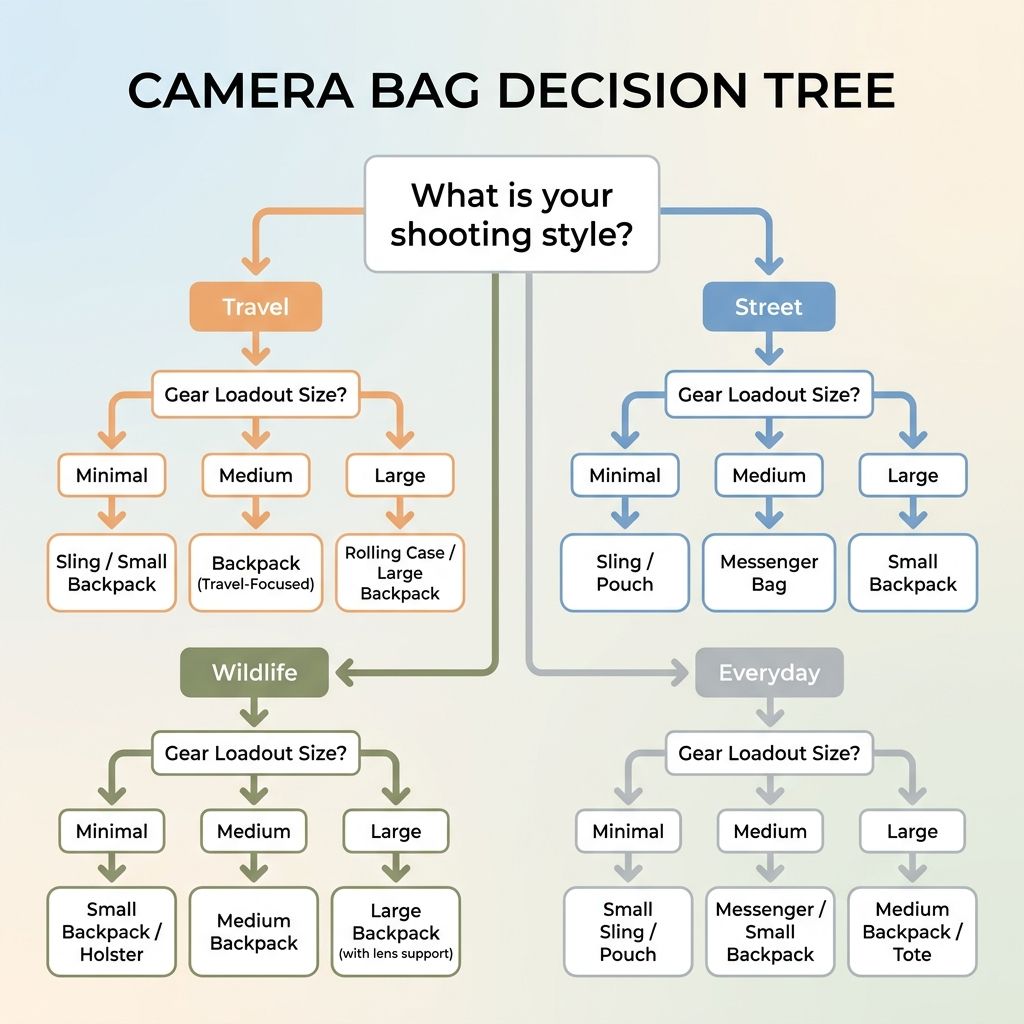
If you want to actually pick the right bag the first time, follow this four-step framework. It takes about 15 minutes.
Tip — Match the bag to your gear, not your wish list > Buying a bag larger than your current kit is the single most common mistake. An oversized bag is heavier, bulkier, and more uncomfortable when carried half-empty. Inventory what you actually own before sizing up. A well-fitted smaller bag beats a loose larger one every time.
Step 1: Define Your Shooting Style
- Travel photographers prioritize carry-on compliance and weather resistance
- Street photographers prioritize stealth, access speed, and minimal weight
- Wildlife and hiking photographers prioritize comfort, capacity, and durability
- Studio and pro shooters prioritize organization and gear protection
- Everyday carry users prioritize versatility, laptop compartments, and commute comfort
Step 2: Inventory Your Gear Loadout
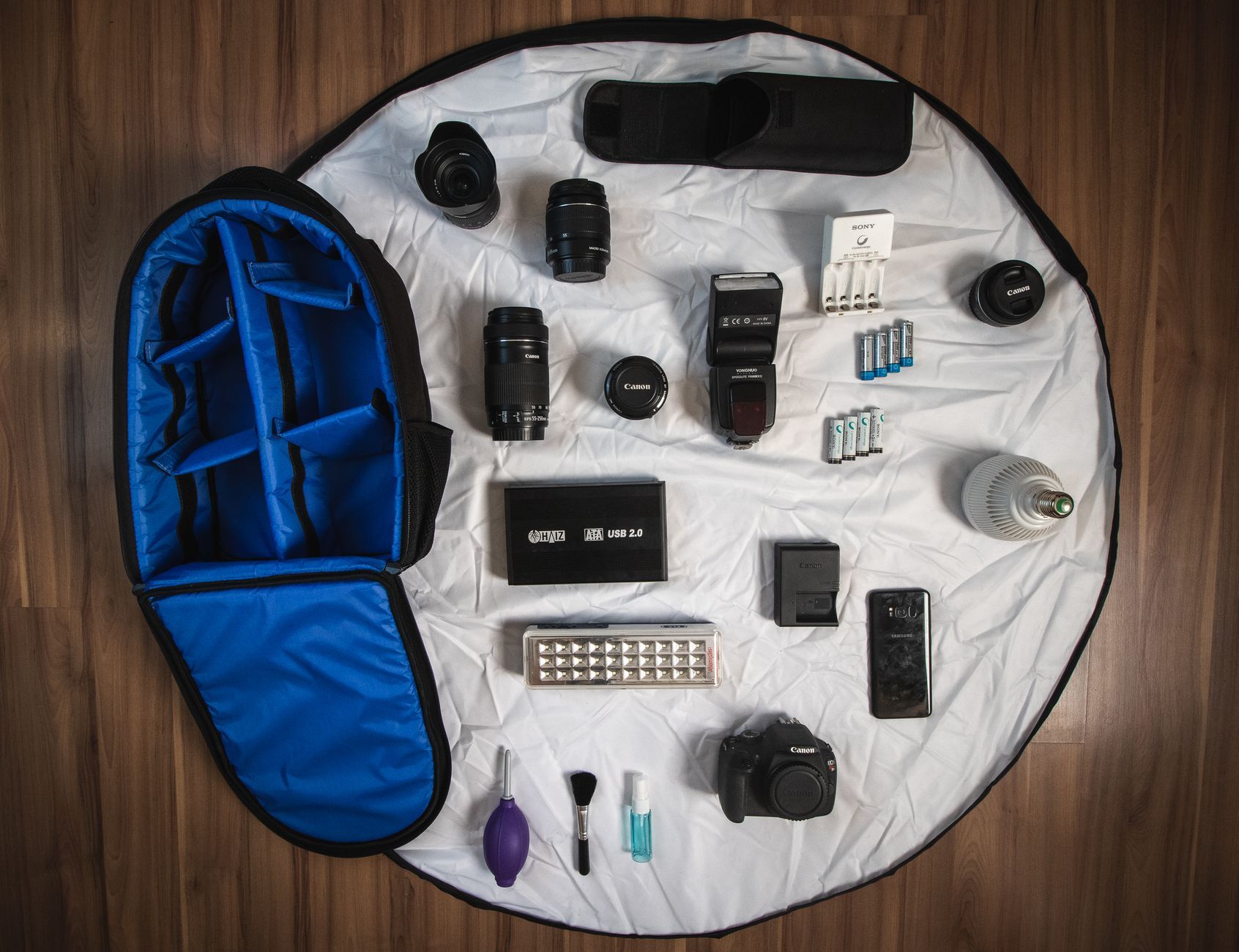
- List every item you plan to carry: body, lenses by size, laptop, batteries, filters, personal items
- Heavier kits (full-frame with telephoto) need backpacks with hip belt support
- Minimal kits (mirrorless with one or two primes) fit comfortably in a sling or small tote
- Factor in future gear growth, but don't oversize for gear you may never buy
Step 3: Prioritize Your Four Criteria
- Rank protection, access, comfort, and stealth in order of importance for your use case
- A wildlife shooter ranks comfort first. A street shooter ranks stealth and access above everything.
- Use the ranking to eliminate bags that underperform on your top two criteria
- No bag scores perfectly across all four. Trade-offs are the whole game.
Step 4: Check Fit, Compliance, and Warranty
- Verify carry-on dimensions against your most-flown airline's official policy before buying
- Confirm internal dimensions fit your largest lens with a body attached
- Review warranty terms on the brand's official site. Lifetime warranties vary significantly in what they cover.
- Check whether a rain cover is included or sold separately
Camera Bag Selection Checklist
- Identified my primary shooting style
- Listed every item I need to carry
- Ranked the four criteria by importance for my use case
- Checked carry-on dimensions if I travel with my kit
- Confirmed weather resistance level and rain cover inclusion
- Compared warranty terms between shortlisted bags
- Set a realistic budget range
Key Buying Considerations
A camera sling is a single-strap bag that rotates to the front for one-handed access, best for street and event photographers with small kits. A camera backpack distributes weight across both shoulders, handles larger kits, and usually includes a laptop compartment, which makes it better for travel and all-day shoots. The right choice comes down to how much gear you carry and how fast you need to reach it.
| Form Factor | Best For | Typical Capacity | Access Speed | Laptop Carry |
|---|---|---|---|---|
| Backpack | Large kits, travel, hikes, all-day use | 15L–50L | Medium | Yes |
| Sling | Compact kits, street, events | 3L–10L | Fast | No |
| Messenger | Urban shooters, quick top access | 8L–20L | Fast | Optional |
| Tote | Minimal kits, studio-to-cafe use | 5L–15L | Medium | Optional |
| Rolling case | Studio pros, checked travel | 30L–80L+ | Slow | Yes |
Example — Sling vs Backpack: The Quick Answer > A sling uses one strap and rotates to the front for one-handed access. It's ideal for a mirrorless body with one or two lenses on a street walk. A backpack uses two straps, distributes heavier loads evenly, and typically carries a laptop. It's the right choice when you're moving a full kit through an airport or on an all-day shoot.
Form Factor: Which Bag Style Is Right for You?
- Backpacks: best for large kits, all-day carry, travel, and hikes. Heavier but most versatile.
- Slings: best for compact kits, fast access, and street or event photography.
- Messenger bags: suit urban shooters who prefer shoulder carry and quick top access.
- Totes: casual option for minimal kits and studio-to-cafe use. Least weatherproof.
- Rolling cases: for studio photographers and traveling pros who check rather than carry on.
Laptop and Personal Item Compatibility
- Many premium camera backpacks include dedicated laptop sleeves for 13-inch to 16-inch laptops
- Confirm whether the laptop compartment is padded and whether it separates from the camera section
- Some bags double as both personal item and camera carry, useful for avoiding checked baggage fees
- If you edit in the field, a laptop sleeve that opens independently saves significant time
Weather Protection: What 'Weather-Resistant' Actually Means
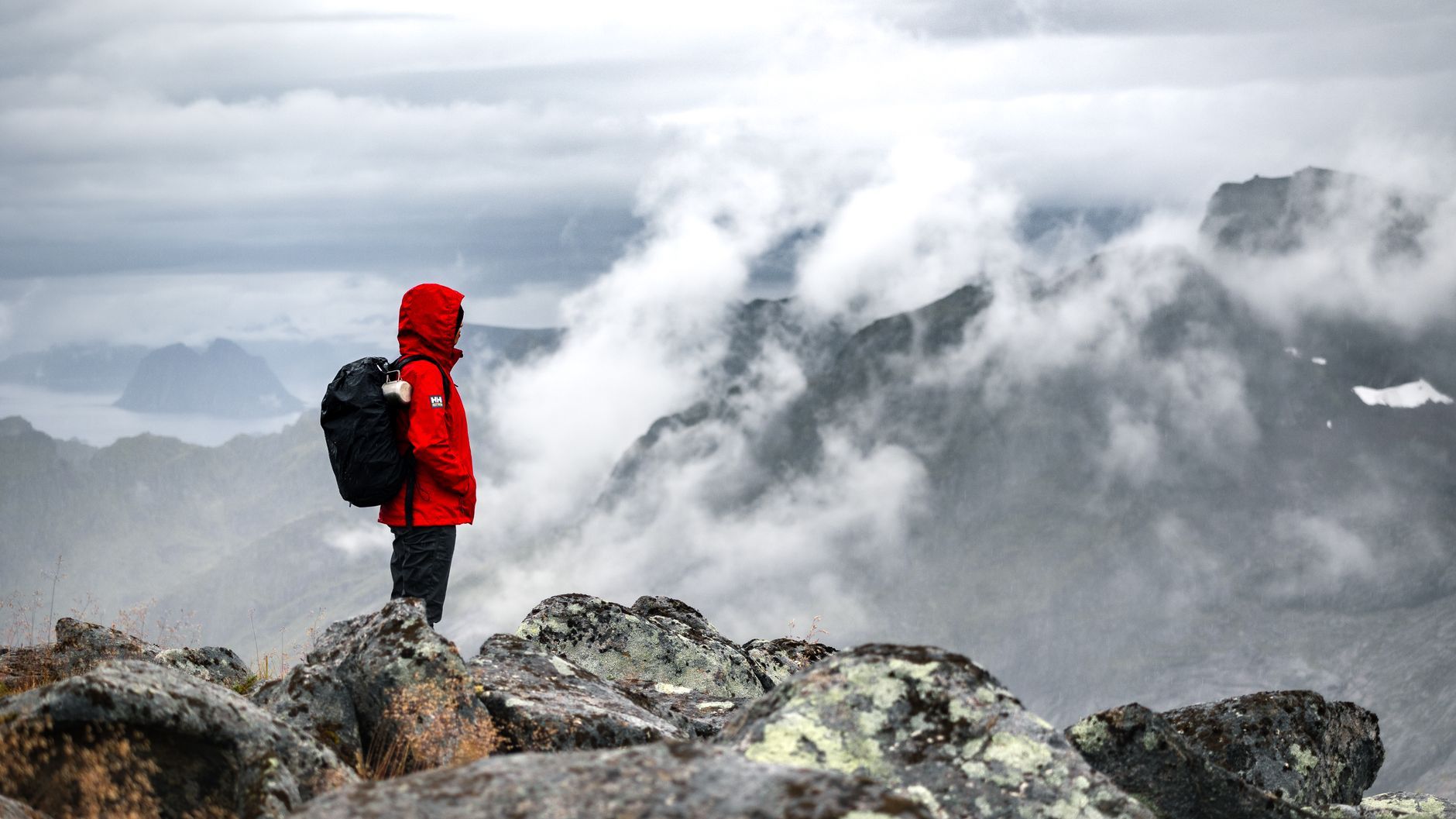
Most consumer camera bags are weather-resistant, not waterproof. They'll handle light rain, drizzle, and brief exposure fine, but sustained heavy rain will eventually penetrate most bags, usually through the zippers. Protection level depends on the outer material, the zipper type, and whether a rain cover is included. This distinction matters because "waterproof" implies a formal rating that very few soft camera bags carry.
| Bag Name | Outer Material | Zipper Type | Rain Cover Included | Weather Resistance Level |
|---|---|---|---|---|
| WANDRD PRVKE | Tarpaulin / coated nylon | YKK | No (roll-top seals) | High |
| Peak Design Everyday Backpack | Recycled weatherproof shell | Weather-resistant zips | No | High |
| Peak Design Everyday Sling | Recycled weatherproof shell | Weather-resistant zips | No | Medium |
| Shimoda Explore | Weather-resistant nylon | YKK | Optional (sold separately on some SKUs) | High |
| Lowepro Tahoe BP 150 | Polyester | Standard | Yes (AW cover) | Medium |
| Nomatic x McKinnon | Water-resistant nylon | YKK | Check model | Medium-High |
Warning — No camera bag is truly waterproof > Virtually all consumer camera bags are water-resistant, not waterproof. Heavy or sustained rain will eventually penetrate most bags through the zippers. Always use the included rain cover or buy a third-party universal cover for extended outdoor shooting. Don't set your bag on wet ground for long periods even with a cover on.
Materials and Zipper Types Explained
- High-denier nylon (600D and above) resists abrasion and repels light rain better than polyester at the same weight
- YKK zippers are the industry durability standard. YKK AquaGuard adds improved water sealing.
- Coated fabrics add water repellency, but coatings degrade over time with UV exposure and washing
- Roll-top closures like those on the WANDRD PRVKE seal better than zip-top designs in sustained rain
Rain Covers: Included vs Sold Separately
- Some bags include integrated rain covers stored in a dedicated bottom pocket. Confirm on the manufacturer's product page.
- Third-party universal rain covers are inexpensive and work with any bag that lacks one
- Lowepro's AW (All Weather) line is known for including integrated covers as a standard feature
- Even with a rain cover, avoid submerging the bag or leaving it on saturated ground
Carry-On Compliance for Travel Photographers
Yes, most camera backpacks can serve as airline carry-on luggage, but compliance depends entirely on the specific airline's size limits and your bag's packed dimensions. Bags in the 20–26L range typically fit major airline limits. Larger expedition packs usually don't. Always verify current dimensions on your airline's official baggage page before every trip, because policies change. General guidance from the International Air Transport Association is a useful starting point, but individual carriers set their own limits.
| Airline | Max Carry-On Dimensions (inches) | Max Weight (lbs) | Personal Item Allowed |
|---|---|---|---|
| Delta | 22 x 14 x 9 | No published limit (reasonable) | Yes |
| United | 22 x 14 x 9 | No published limit | Yes |
| American | 22 x 14 x 9 | No published limit | Yes |
| Southwest | 24 x 16 x 10 | No published limit | Yes |
| British Airways | 22 x 18 x 10 | ~51 lbs | Yes |
| Ryanair | 21.6 x 15.7 x 7.8 (priority) | 22 lbs | Smaller free bag only |
| — | Verify current limits with your airline before travel | — | — |
Warning — Airline carry-on limits vary and change > The table above is reference only. Dimensions and weight limits change, sometimes with short notice, and differ by route and fare class. Verify your specific airline's current policy on their official site before every trip. IATA guidance provides a general baseline.
Which Bags Are Most Likely to Be Carry-On Compliant?
- Bags in the 20–26L range tend to fall within most major airline limits. Always verify.
- Expandable bags can exceed limits when fully expanded. Measure in packed configuration.
- Backpacks over 45L are almost universally too large for carry-on
- Some bags are explicitly marketed as airline carry-on compliant. Confirm dimensions on the manufacturer's page.
Pre-Travel Camera Bag Compliance Checklist
- Measured bag dimensions (H x W x D) with gear loaded
- Checked airline's current carry-on limit on their official site
- Confirmed bag qualifies as carry-on or personal item on my route
- Considered whether a smaller personal item can carry camera gear
- Packed heaviest items (body, lenses) in carry-on to avoid checked-bag damage
- Know my airline's gate-check policy if overhead bins fill
How Much Should You Spend on a Camera Bag?
Let's break down the actual costs. Camera bags span from roughly $30 to well over $400. More money generally buys better materials, smarter access systems, and longer warranties, but the sweet spot for most photographers is mid-range to premium.
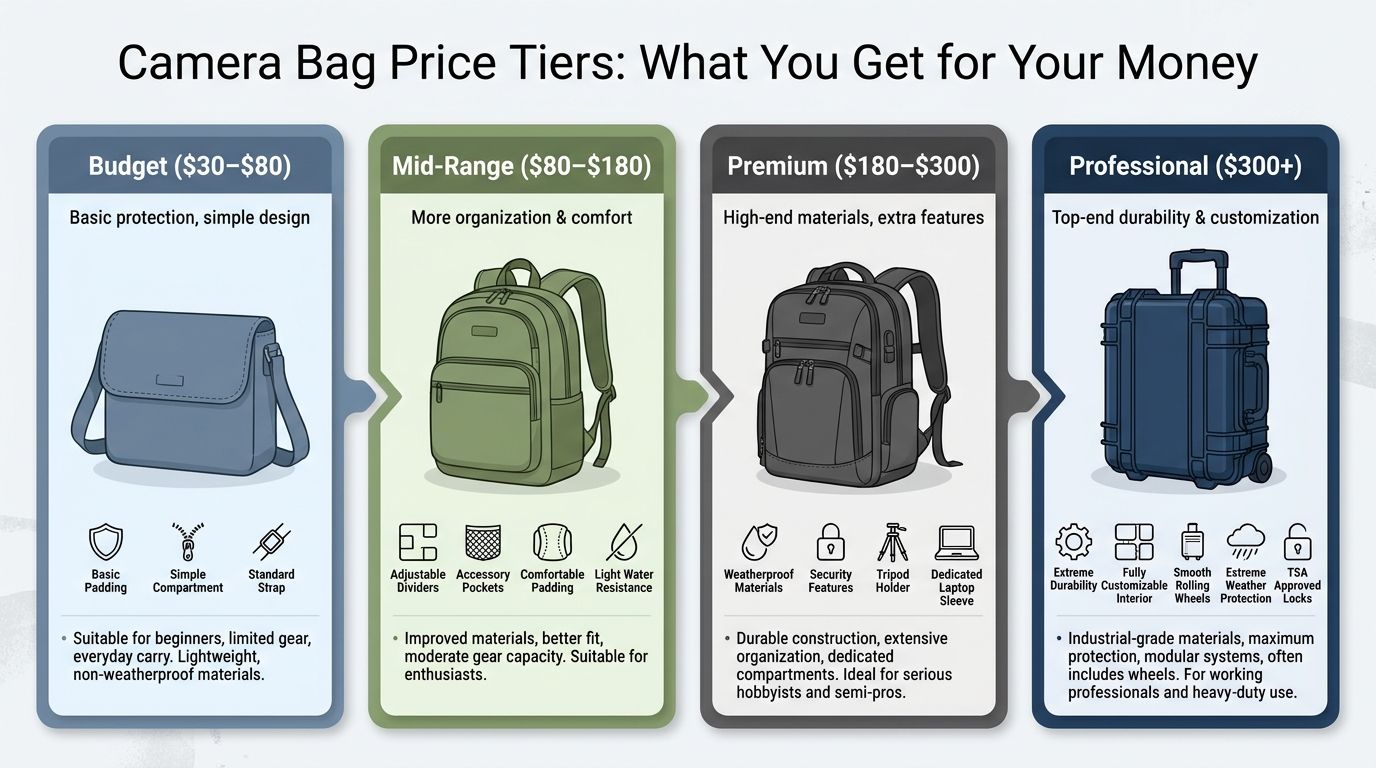
| Tier | Approx. Price Range (USD) | What You Get | Example Bags |
|---|---|---|---|
| Budget | $30–$80 | Basic padded dividers, polyester shell, standard zippers, functional but minimal ergonomics | Lowepro Tahoe BP 150, AmazonBasics |
| Mid-Range | $80–$180 | Better materials, more organization, often a laptop sleeve, improved comfort | Lowepro ProTactic (smaller), Manfrotto Advanced |
| Premium | $180–$300 | High-denier weatherproof fabrics, YKK zippers, refined access systems, lifetime warranty on some brands | Peak Design Everyday Backpack, WANDRD PRVKE |
| Professional | $300+ | Modular systems, pro capacity, heavy-duty hardware, expedition-grade durability | Nomatic x McKinnon, Shimoda Explore, f-stop Tilopa |
Prices are approximate and sourced from manufacturer pages at time of writing. Verify current pricing before purchase.
Tip — Consider total cost of ownership > A premium bag with a lifetime warranty from a brand like Peak Design or WANDRD costs more up front but replaces itself for free if it fails. Over a 5–10 year horizon, that can work out cheaper than buying two or three budget bags. Factor warranty terms into your comparison.
Is a Premium Camera Bag Worth It?
Here's the honest answer: it depends on how often you shoot.
- Premium bags use higher-denier fabrics, YKK zippers, and injection-molded hardware that resist wear significantly longer
- Lifetime warranties from brands like Peak Design cover manufacturing defects and offset the higher upfront cost
- For photographers who shoot daily or travel frequently, premium durability and ergonomics usually justify the investment. This will pay for itself across years of use instead of two or three bag replacements.
- Casual or occasional photographers with modest kits often find mid-range bags fully adequate
Frequently Asked Questions About Camera Bags
What is the best camera bag for travel photography?
The WANDRD PRVKE and Peak Design Everyday Backpack are the two most frequently cited options for travel photographers across independent reviewers at DPReview and PetaPixel. Key criteria for travel are carry-on compliance, weather resistance, comfortable straps for airport wear, and secure access design. Always verify carry-on dimensions against your airline's current policy before purchasing.
What should I look for in a camera backpack?
Prioritize the four criteria: protection (padded dividers and a durable shell), access (quick-draw zip options), comfort (ventilated back panel and adjustable straps), and stealth (low-profile, non-branded design). Also check laptop compartment size, weather resistance, warranty terms, and carry-on compliance if you travel with your kit.
Are camera backpacks allowed as carry-on luggage?
Most camera backpacks in the 20–26L range fit major airline carry-on limits, but compliance depends on packed dimensions and the specific airline's policy. Always measure your loaded bag and verify dimensions on your airline's official baggage page before every trip. Bags over 40L are rarely carry-on compliant and may need to be checked.
What is the difference between a camera sling and a camera backpack?
A camera sling uses a single strap and rotates to the front for fast one-handed access, best for compact kits and street or event photography. A camera backpack distributes weight across both shoulders, holds larger kits, and typically includes a laptop compartment, which makes it better for travel and all-day shoots. The right choice depends on gear volume and how fast you need to reach your camera.
How much should I spend on a camera bag?
Budget bags ($30–$80) work for occasional shooters with minimal kits. Mid-range ($80–$180) adds better build quality and organization. Premium bags ($180–$300+) offer superior materials, ergonomics, and often lifetime warranties that offset the higher cost over time. Match the investment to how often you shoot. A daily shooter benefits far more from a premium bag than a weekend hobbyist.
Are Peak Design bags worth the price?
Peak Design bags are widely regarded as among the best-designed camera bags available, with strong build quality, smart access systems like the MagLatch and FlexFold dividers, and a lifetime warranty. The premium price reflects high-quality recycled weatherproof materials and refined ergonomics. Daily users generally find the investment worthwhile. Occasional shooters may find comparable value at lower price points. Full specs and pricing are on Peak Design's official site.
Are camera bags waterproof?
Most camera bags are weather-resistant, not waterproof. They handle light rain but will not withstand sustained heavy rain without a rain cover. Look for high-denier coated fabrics and YKK AquaGuard zippers for the best weather resistance available in a soft bag. Always use the included rain cover or buy a third-party cover for outdoor and travel shoots in unpredictable weather.