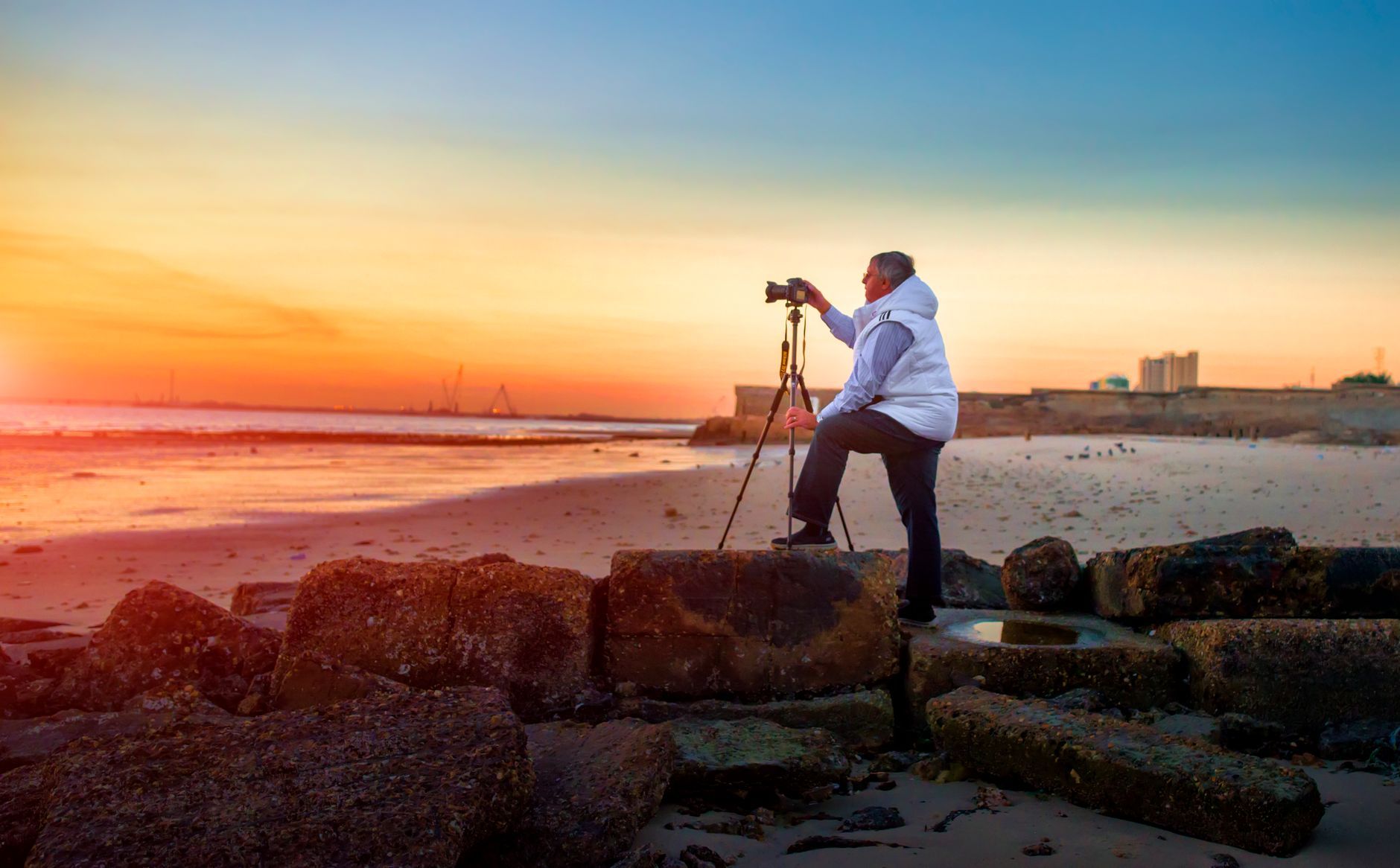
What is the best travel tripod for photographers in 2026?
Quick answer: The best travel tripod for most photographers in 2026 is the Peak Design Travel Tripod, offering an exceptional balance of compact folded size (around 40 cm / 15.7 in), low weight (1.27 kg / 2.8 lb in carbon fiber), and a tool-free ball head. For tighter budgets, the Sirui T-0S and Manfrotto Befree Advanced deliver strong value without sacrificing stability or packability.
Researched and compared: the best travel tripods for 2026. Find lightweight carbon fiber and aluminum picks for hiking, vlogging, landscapes, and every budget.
Key Takeaways
- Prioritize a folded length under 45 cm (17.7 in) so the tripod fits in a carry-on or backpack side pocket.
- Choose carbon fiber over aluminum when weight savings matter more than budget.
- Always pick a tripod rated at least twice the combined weight of your camera and heaviest lens.
- Ball heads suit stills; a fluid or pan-tilt head is worth the extra weight for video work.
- Twist locks keep a slim profile; flip locks give faster one-glance confirmation they are secure.
- Budget picks (under $150) can deliver solid stability — compromises show up in folded size and head quality.
- Check actual airline carry-on dimensions before every trip; no single tripod is guaranteed compliant with all airlines.
Here's the reality: there are dozens of travel tripods out there, and the wrong choice costs you twice. Either it's too heavy and stays home the day you actually need it, or it's too flimsy and wobbles through every long exposure you take. This guide cuts through the noise with researched picks across every budget tier — under $150, $150–$350, and $350-plus — with specs cross-referenced against manufacturer pages and dual metric/imperial measurements throughout.
We cover landscape work, hiking, backpacking, vlogging, and everyday travel. If you want to understand the specs before you buy, jump to the buying criteria. If you just want to see the picks, scroll to the comparison table. And unlike most guides, we address the carry-on question directly — because nothing ruins a trip faster than getting flagged at the gate.
Affiliate disclosure: Photography Launchpad uses affiliate links where applicable. This never influences our rankings. Every pick is based on the evaluation criteria described later in this guide.
<a id="overview"></a> ## What Makes a Great Travel Tripod?
A travel tripod is a camera support engineered to collapse small, weigh little, and still hold your camera steady enough for sharp images. It typically folds under 45 cm (17.7 in), weighs under 1.6 kg (3.5 lb), and uses 4–5 leg sections so it can slip into a backpack pocket or a carry-on bag. Everything else — the head, leg locks, materials — flows from those three priorities.
💡 Travel Tripod vs. Standard Tripod > > A typical studio or landscape tripod weighs 1.8–3 kg (4–6.6 lb) and folds to 60–70 cm (23.6–27.6 in). A travel-spec tripod cuts that roughly in half: under 1.6 kg (3.5 lb) and under 45 cm (17.7 in) folded. You give up some outright rigidity for the ability to actually carry it all day.
The Core Trade-offs to Understand
Every travel tripod is a compromise. Understanding the trade-offs before you shop keeps you from buying the wrong one twice.
- Stability vs. weight: Thinner legs and lighter materials reduce rigidity. There's no free lunch — the lightest tripod in any category will always flex more than a heavier sibling.
- Folded length vs. max height: More leg sections mean a more compact folded profile, but each additional joint adds weight and potential flex. A 4-section leg is the usual sweet spot.
- Head included vs. body-only: Some travel tripods ship as a kit with a ball head; others sell as body-only. Factor the head cost into your real budget.
- Carbon fiber vs. aluminum: Different weights, vibration behavior, cold-weather feel, and price. We cover this fully later.
- Price tiers matter: An $80 tripod and a $600 tripod solve genuinely different problems. The question isn't which is "better" — it's which tier matches your gear and how often you'll use it.
<a id="comparison-table"></a> ## Best Travel Tripods at a Glance: Comparison Table
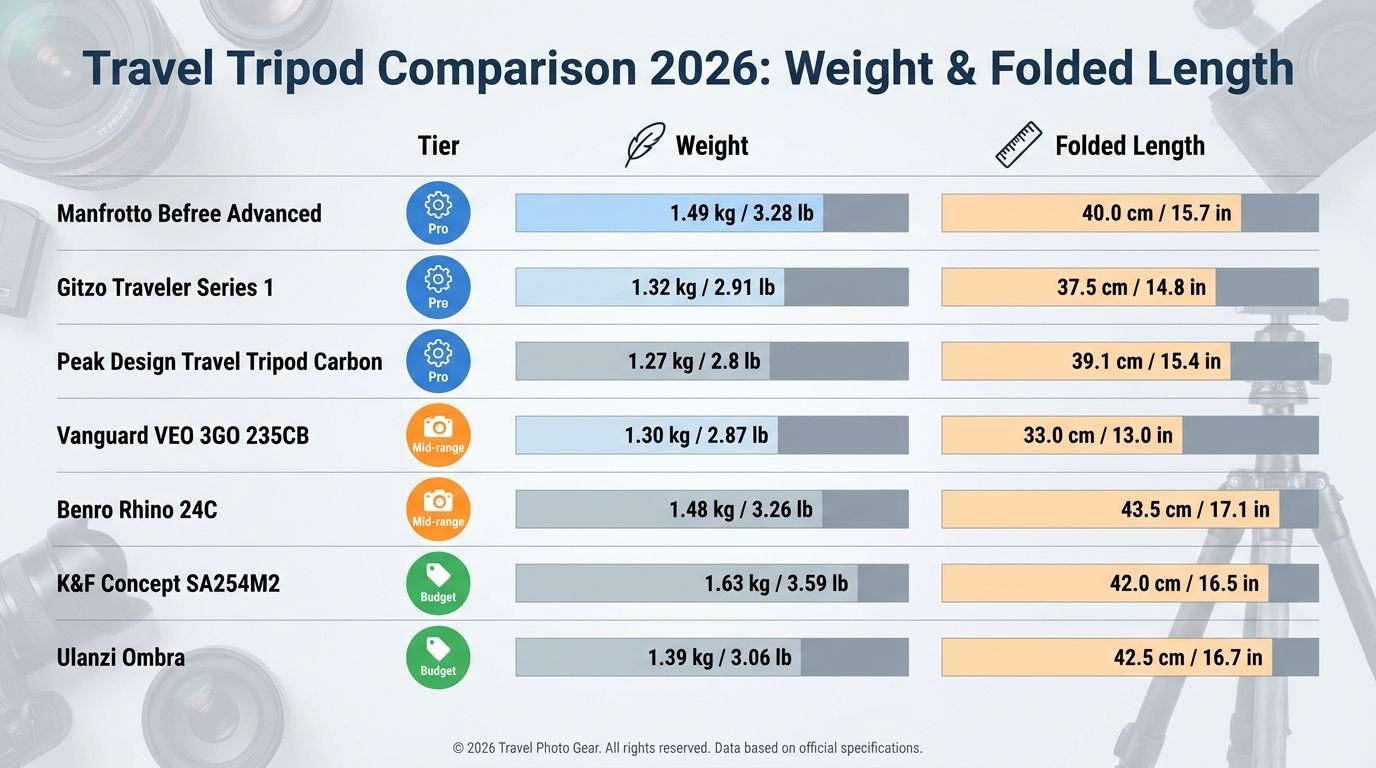
The six picks below cover every budget and use case this guide addresses. Here's the one-line version:
- Peak Design Travel Tripod — Best overall for compact packability
- Gitzo Series 1 Traveler — Best pro-tier pick for working photographers
- Sirui T-0S — Best value carbon fiber for weight-conscious hikers
- Manfrotto Befree Advanced — Best lightweight all-rounder with brand support
- 3 Legged Thing Leo — Most stable mid-range pick for heavier gear
- Joby GorillaPod 5K — Best for vlogging and creative angles
Best Travel Tripod Comparison 2026
| Tripod | Material | Weight | Folded Length | Max Height | Max Load | Price Range | Best For |
|---|---|---|---|---|---|---|---|
| Peak Design Travel Tripod (CF) | Carbon fiber | 1.27 kg / 2.8 lb | 39.1 cm / 15.4 in | 152.4 cm / 60 in | 9.1 kg / 20 lb | $$ | Best overall |
| Gitzo Series 1 Traveler | Carbon fiber | ~1.45 kg / 3.2 lb | ~42.5 cm / 16.7 in | ~165 cm / 65 in | 10 kg / 22 lb | $$$ | Pro / working photographers |
| Sirui T-0S | Carbon fiber | ~0.8 kg / 1.76 lb | ~30.5 cm / 12 in | ~130 cm / 51 in | 4 kg / 8.8 lb | $ | Value carbon fiber, hikers |
| Manfrotto Befree Advanced (AL) | Aluminum | 1.55 kg / 3.42 lb | 40 cm / 15.7 in | 150 cm / 59 in | 8 kg / 17.6 lb | $ | Lightweight all-rounder |
| 3 Legged Thing Leo 2.0 | Magnesium alloy / CF | ~1.56 kg / 3.44 lb | ~40 cm / 15.7 in | ~148 cm / 58.3 in | 30 kg / 66 lb | $$ | Heavier mirrorless/DSLR kits |
| Joby GorillaPod 5K | Aluminum + composite | ~0.74 kg / 1.63 lb | ~36 cm / 14.2 in | Flexible | 5 kg / 11 lb | $ | Vlogging, creative angles |
Specs sourced from manufacturer product pages; verify current specs and prices directly with the manufacturer or retailer before purchase, as they change frequently.
💡 How to Read This Table > > Manufacturer load ratings are maximum figures, not recommended shooting weights. In the real world, wind, vibration, and dynamic movement eat into that number. Choose a tripod rated at least twice the combined weight of your camera and your heaviest lens.
<a id="top-picks"></a> ## Our Top Travel Tripod Picks for 2026
⚠️ Specs Accuracy Note > > All specs below are sourced from manufacturer product pages as of 2026. Specifications, variants, and prices change — always verify current figures on the manufacturer or retailer site before buying. Price ranges are approximate and vary by region and retailer.
Peak Design Travel Tripod — Best Overall
Material: Carbon fiber (aluminum variant also available) Weight: 1.27 kg / 2.8 lb (CF); 1.56 kg / 3.44 lb (AL) Folded length: 39.1 cm / 15.4 in Max height: 152.4 cm / 60 in Max load: 9.1 kg / 20 lb
The Peak Design Travel Tripod earns its "best overall" spot through one clever design choice: the legs wrap tightly around a non-traditional center column, eliminating the dead space in a standard folded tripod. The result is a profile closer to a water bottle than a tripod — and that matters when it's going in your carry-on every flight. Specs and dimensions are listed on the Peak Design Travel Tripod product page.
The integrated Arca-Swiss-compatible ball head uses a tool-free ring to lock and unlock, and leg angle adjustments require no buttons or latches. It's genuinely one of the fastest tripods to deploy from a packed state.
Pros: - Exceptionally compact folded profile for its deployed height - Premium build quality and sealed hardware - Tool-free setup across the board; integrated Arca-Swiss head
Cons: - Highest price tier among mainstream travel tripods - Ball head isn't easily swappable for a fluid head - Compact leg joints need care in sand and grit
Best for: Photographers who prioritize packability above all and are willing to pay for an all-in-one premium solution.
Gitzo Series 1 Traveler — Best Pro Pick
Material: Carbon fiber (Carbon eXact tubes) Weight: ~1.45 kg / 3.2 lb (body-only) Folded length: ~42.5 cm / 16.7 in Max height: ~165 cm / 65 in Max load: 10 kg / 22 lb
Gitzo built its reputation on tripods that outlast the cameras mounted to them, and the Series 1 Traveler is the travel-ready expression of that philosophy. The Carbon eXact tubes combine thin-wall carbon with higher modulus fibers for stiffness-to-weight gains, and the G-lock Ultra twist locks are specifically sealed against dust and moisture — the exact failure point on most travel tripods used in rough conditions.
Note that Gitzo sells both body-only and kit configurations. Check the specific SKU for whether a ball head is included; many working photographers pair the Traveler body with a separate head of their choice.
Pros: - Excellent vibration dampening from Carbon eXact tube design - Weather-sealed twist locks resist grit and moisture - Long-term durability widely reported by professional landscape photographers
Cons: - Highest price tier in this guide - Max height is modest for the leg count - Head often sold separately — adds to total cost
Best for: Working travel and landscape photographers who shoot in demanding conditions and want gear that lasts.
Sirui T-0S — Best Value Carbon Fiber
Material: Carbon fiber Weight: ~0.8 kg / 1.76 lb Folded length: ~30.5 cm / 12 in Max height: ~130 cm / 51 in Max load: 4 kg / 8.8 lb
If you want carbon fiber without the pro-tier price, the T-0S is the usual answer. It's one of the lightest carbon fiber travel tripods on the market and folds down short enough to disappear inside a daypack. According to Sirui's tripod lineup, it ships with a compact ball head and uses twist-lock legs.
The trade-off is maximum load: at 4 kg (8.8 lb), it's best suited to mirrorless bodies with compact to mid-size lenses. Mount a heavy pro telephoto and you'll start seeing the limits.
Pros: - Impressively light for a sub-$250 tripod - Compact folded size ideal for backpacks and carry-ons - Solid build quality at the price
Cons: - Lower load rating than premium alternatives - Shorter max height — tall photographers will extend the center column - Less refined hardware than Peak Design or Gitzo
Best for: Weight-obsessed hikers and backpackers shooting mirrorless with compact lenses.
Manfrotto Befree Advanced — Best Lightweight All-Rounder
Material: Aluminum or carbon fiber variants Weight: 1.55 kg / 3.42 lb (AL); 1.25 kg / 2.76 lb (CF) Folded length: 40 cm / 15.7 in Max height: 150 cm / 59 in Max load: 8 kg / 17.6 lb
The Befree Advanced is what you recommend to a friend who doesn't want to overthink this. It folds small, holds 8 kg (17.6 lb), and the flip-lock legs give you one-glance confirmation they're closed — which matters at 4 a.m. when you're setting up for sunrise. Full specs for both materials are on the Manfrotto Befree Advanced page.
The included ball head has a separate pan lock, which is handy for leveling horizons without unlocking the whole ball. Brand support, parts availability, and the accessory ecosystem are all genuinely strong — a quiet advantage five years into ownership.
Pros: - Balanced weight, stability, and price - Flip locks are fast and visually obvious - 8 kg (17.6 lb) load covers most mirrorless and mid-tier DSLR kits
Cons: - Aluminum version is noticeably heavier than carbon fiber peers - Center column limits low-angle work unless inverted - Less compact folded than the Peak Design
Best for: Travel photographers who want a trusted brand and fast setup over absolute weight savings.
3 Legged Thing Leo 2.0 — Most Stable Mid-Range Pick
Material: Magnesium alloy with carbon fiber legs Weight: ~1.56 kg / 3.44 lb Folded length: ~40 cm / 15.7 in Max height: ~148 cm / 58.3 in Max load: 30 kg / 66 lb
The headline number on the 3 Legged Thing Leo is the load rating: 30 kg (66 lb) on a tripod that weighs just 1.56 kg (3.44 lb). That's achieved through magnesium alloy castings at the stress points and a leg brace design built for rigidity rather than minimum folded size.
For context: this is the tripod to buy if you shoot a heavier mirrorless body with a 70–200 f/2.8 or a DSLR with pro glass and you refuse to compromise on stability. Warranty terms are published on the manufacturer site — verify current terms directly.
Pros: - Exceptional rigidity for the weight class - High load rating handles heavier DSLR and mirrorless setups - Published long-term warranty — verify current terms
Cons: - Slightly bulkier folded than ultra-compact competitors - Mid-tier price pushes toward pro territory
Best for: Photographers using heavier camera-and-lens combos who can't compromise on stability.
Joby GorillaPod 5K — Best for Vlogging and Creative Angles
Material: Aluminum + composite flexible joints Weight: ~0.74 kg / 1.63 lb Folded length: ~36 cm / 14.2 in Max load: 5 kg / 11 lb
The GorillaPod 5K isn't a traditional tripod and shouldn't be compared as one. Its flexible-joint legs wrap around railings, tree branches, and uneven rocks — which makes it uniquely useful for vloggers, street shooters, and travelers who shoot in tight urban environments. It also doubles as a handheld grip for walking B-roll.
Just know its limits: it won't put a camera at eye level, and it isn't the right tool for 30-second landscape exposures. Think of it as a versatile companion, not a primary long-exposure tool.
Pros: - Unmatched versatility for creative positioning - Doubles as a handheld vlogging grip - Compact and light enough for everyday carry
Cons: - Can't match a rigid tripod on long exposures - Limited maximum height - Composite joints will wear with heavy daily use
Best for: Vloggers, travel content creators, and street photographers who need lightweight multi-purpose support.
<a id="use-case-picks"></a> ## Best Travel Tripod by Use Case
Different trips, different priorities. Here's how the top picks shake out by shooting style.
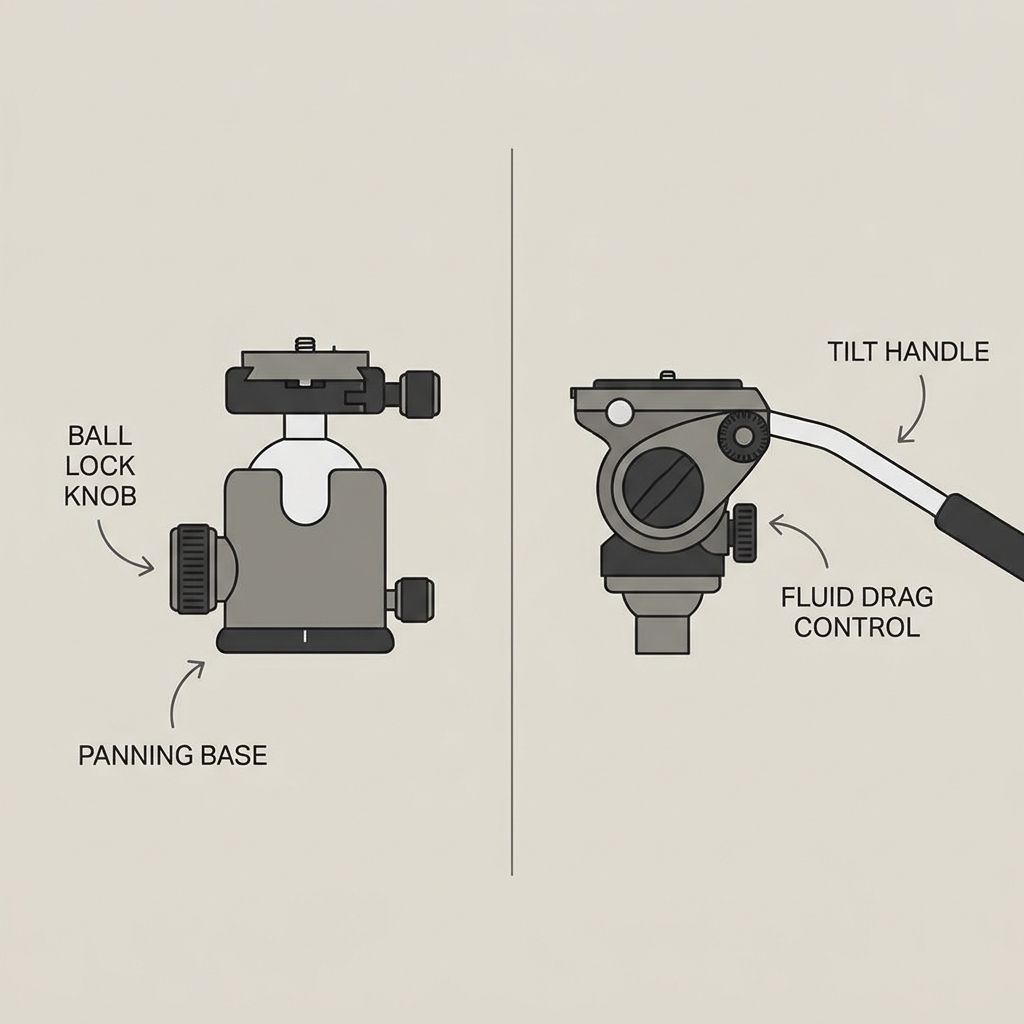
💡 Video Head vs. Ball Head for Travel > > A fluid head or pan-tilt head produces much smoother panning movements than a ball head — the difference is immediately visible in video. The trade-off: a video-capable head adds 200–500 g (0.4–1.1 lb) and more bulk. If you're a vlogger, this weight is worth it. If video is occasional, stick with a ball head.
Best for Hiking and Backpacking
For trail days, the Sirui T-0S wins on the one metric that matters: weight on your back. At ~0.8 kg (1.76 lb) and folded under 32 cm (12.6 in), it disappears into a 30L pack.
- Target sub-1 kg (2.2 lb) weight and folded length under 40 cm (15.7 in)
- Look for a center column hook so you can hang your pack as windproof ballast
- Every 100 g (3.5 oz) counts across a full day of climbing
Best for Video and Vlogging
For casual video, the Joby GorillaPod 5K is the most versatile travel pick, since its flexible legs let you mount anywhere and it doubles as a handheld grip. For planned video work, the Peak Design Travel Tripod with an aftermarket Arca-Swiss-compatible fluid head delivers smoother pans.
- Smooth video panning needs a fluid or pan-tilt head, not a ball head
- Check whether your chosen tripod accepts an Arca-Swiss or flat-base fluid head before buying
- Fluid heads typically add 200–500 g (0.4–1.1 lb) over ball heads — plan for that extra weight
Best for Landscape and Long Exposure
For landscape and long-exposure work, the Gitzo Series 1 Traveler is hard to beat. Carbon fiber damps the micro-vibrations that ruin a 15-second shutter, and the sealed twist locks keep ocean spray out of the leg mechanism.
- Prioritize at least 140 cm / 55 in max height without extending the center column
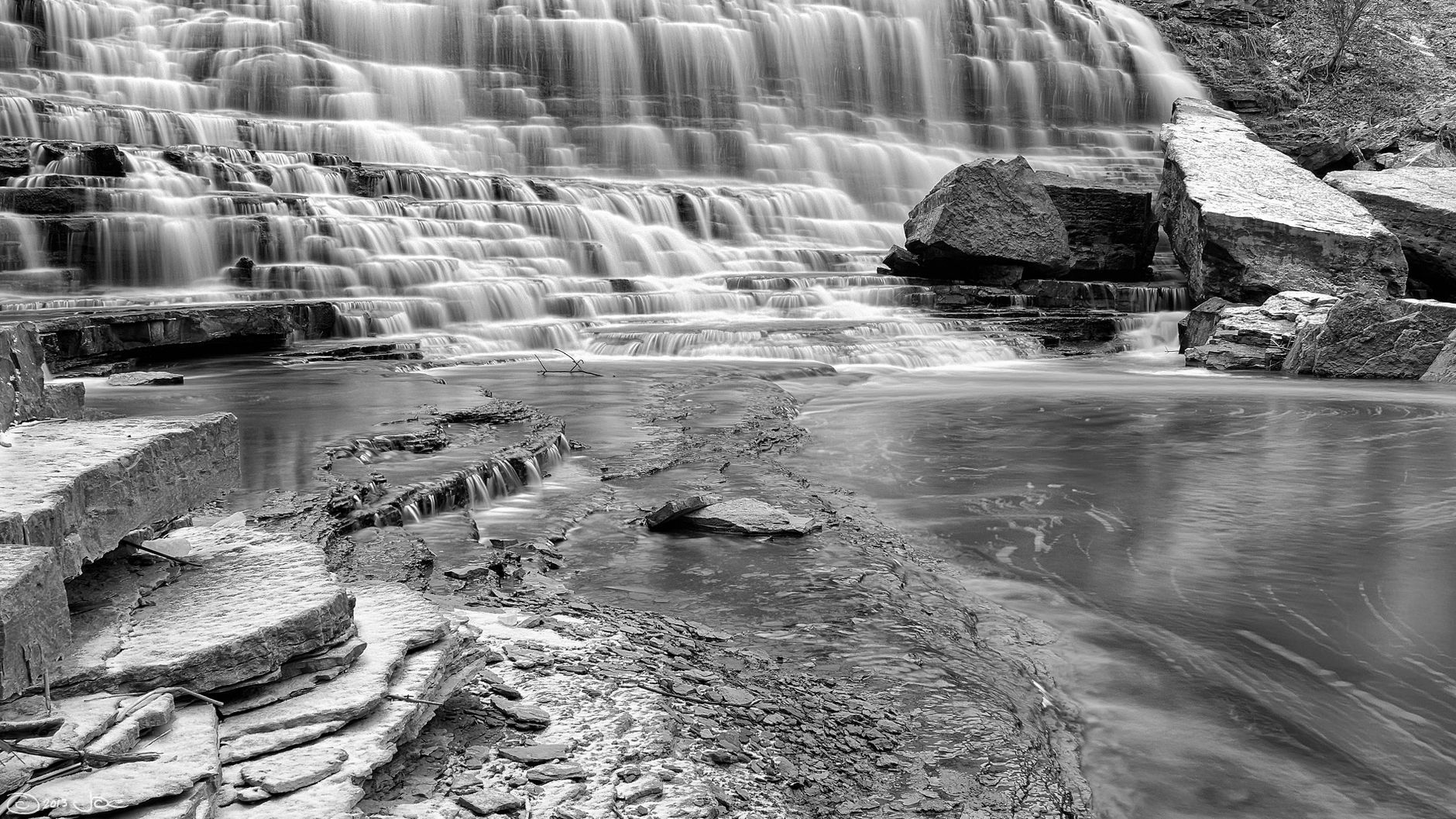
- Carbon fiber matters more here — vibration shows up as softness in long exposures
- A center column hook for bag weight and a reliable cable release are both real-world useful
Best Budget Travel Tripod (Under $150)
Under $150, the Sirui T-0S sits at the top of the pile if you can stretch — otherwise entry-level aluminum options from Manfrotto, K&F, and Benro will serve. Budget doesn't mean unreliable. It means different trade-offs.
- Expect larger folded size, lower load ratings, and more plastic in the joints
- A well-chosen $80–150 tripod still produces sharp long-exposure results when used properly (no center column extension, bag for ballast, cable release)
- The real limitation is long-term durability, not single-trip performance
<a id="buying-criteria"></a> ## How to Choose a Travel Tripod: Key Buying Criteria
When choosing a travel tripod, look for weight under 1.6 kg (3.5 lb), a folded length under 45 cm (17.7 in), a load capacity at least twice your camera-plus-lens weight, carbon fiber or aluminum construction, and a lock type (twist or flip) that matches how you shoot. Those five specs decide 90% of the buying decision.
Travel Tripod Buying Checklist
- Weight: under 1.6 kg (3.5 lb) for most travel; under 1.0 kg (2.2 lb) for ultralight hiking
- Folded length: under 45 cm (17.7 in) for carry-on and backpack compatibility
- Max height: at least 140 cm (55 in) without extending the center column
- Load capacity: rated at least 2× your heaviest camera-plus-lens combo
- Material: carbon fiber for best weight-to-stiffness; aluminum for lower cost
- Leg lock type: twist locks for slim profile; flip locks for fast visual confirmation
- Head type: ball head for stills; fluid or pan-tilt head for smooth video panning
- Leg sections: 4–5 for compact folded size; 3 for more rigidity
- Center column: invertible or removable allows low-angle shooting
- Accessories: spike feet, weight hook, and Arca-Swiss compatibility add versatility
Weight and Folded Length
Weight matters most when you're carrying the tripod all day — on a trail, through an airport, between city shoots. For car-based travel, an extra 500 g is barely noticeable; for a 12-mile hike, it's the difference between bringing the tripod and leaving it in the hotel.
The dual-unit benchmark: under 1.6 kg / 3.5 lb and under 45 cm / 17.7 in folded covers most carry-on scenarios and comfortable all-day carry. Ultralight tripods under 1.0 kg (2.2 lb) exist but typically sacrifice either load capacity or max height.
Maximum Height and Number of Leg Sections
More leg sections let the tripod fold smaller but add joints — and each joint is a potential flex point. Four-section legs are the balanced middle ground for most travel tripods.
A critical detail most buyers miss: check max height without extending the center column. Center columns are inherently less stable than legs — the moment you raise one, you lose much of the stability you paid for. A tripod that reaches 155 cm (61 in) only with the column raised is really a 130 cm (51 in) tripod for serious work.
Typical benchmark: 140–155 cm (55–61 in) max height without center column covers eye level for most adults.
Leg Locks: Twist vs. Flip
Twist locks are collars that rotate to tighten. They keep the leg profile slim, have fewer external parts to snag on gear, and when sealed (like Gitzo's G-lock) resist grit and moisture well. The downside: you can't glance at one and immediately know it's locked.
Flip locks are levers that click closed. You see the lock state instantly, which matters at dawn or in the dark. Trade-off: a slightly wider leg profile and individual levers that can break with abuse. Both styles are reliable when well-made — pick the one that fits how you shoot. The B&H Explora tripod selection guide covers this in more depth if you want to go deeper.
Tripod Heads: Ball Head vs. Fluid Head
- Ball head: single ball joint, fast to reposition, compact, light. The default for stills travel photography.
- Fluid head: drag-controlled panning on each axis for smooth video movement. Heavier and bulkier.
- Pan-tilt head: separate controls per axis for precise framing. Great for architecture and video; slower for action.
Many travel tripods sell as either kit (body + ball head) or body-only. Confirm which version you're buying before checkout — a body-only purchase with a surprise $150 head bill ruins the day.
⚠️ Load Rating Does Not Equal Safe Shooting Weight > > Manufacturer load ratings are maximum theoretical capacities tested under ideal static conditions. Vibration, wind, and dynamic use all reduce real-world safe working load. Choose a tripod rated at least 2× the actual weight of your camera plus your heaviest lens — more if you shoot in wind or with long telephotos.
<a id="materials"></a> ## Carbon Fiber vs. Aluminum: Which Should You Choose?
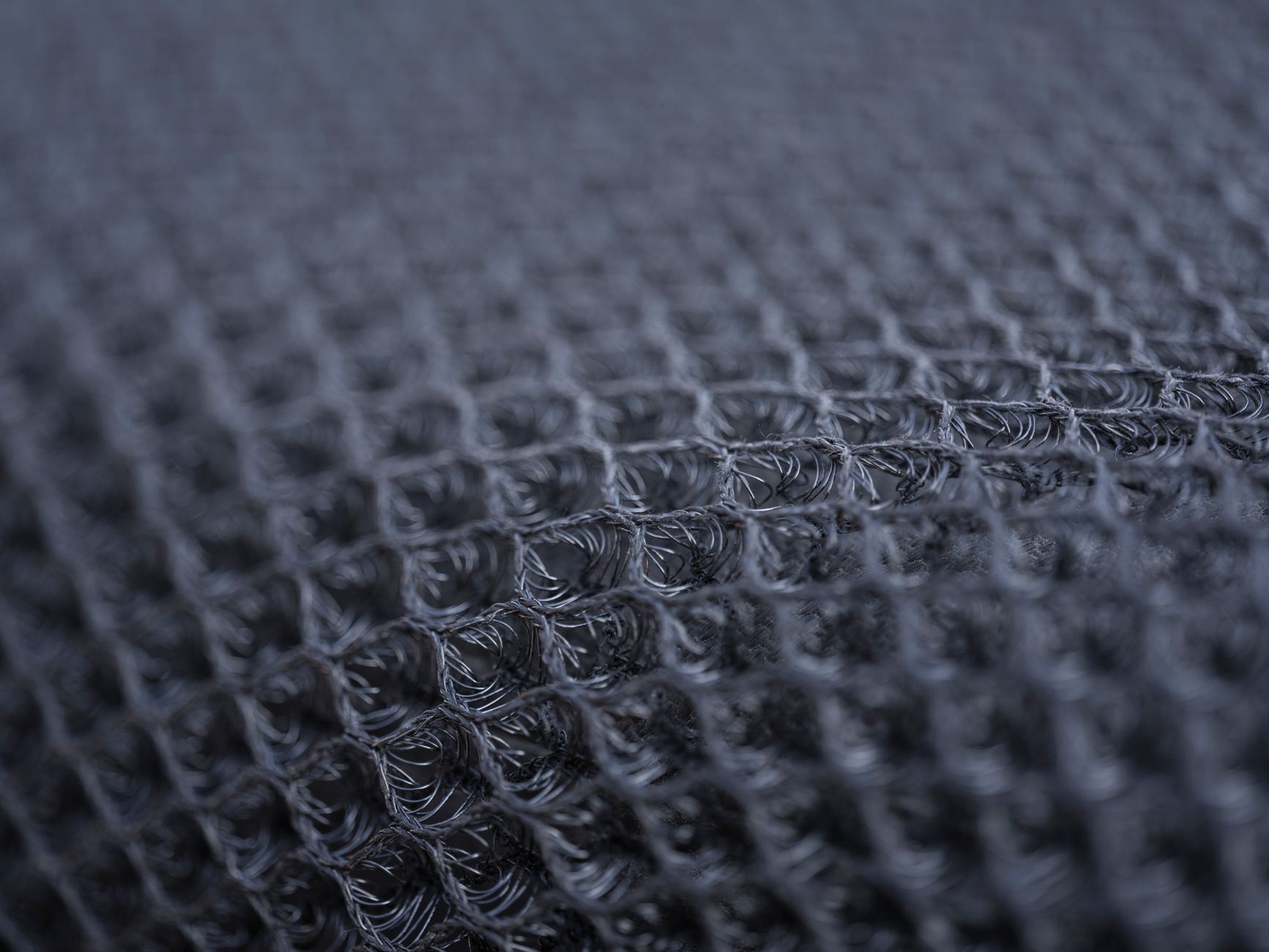
Carbon fiber and aluminum each have real advantages — this isn't a case where one wins outright. The decision comes down to budget, how much you'll carry it, and where you shoot.
Carbon Fiber vs. Aluminum Tripod: At a Glance
| Factor | Carbon Fiber | Aluminum |
|---|---|---|
| Weight (same size) | Lighter (~20–30% less) | Heavier |
| Vibration dampening | Better — absorbs micro-vibration | Transmits vibration more directly |
| Cold-weather feel | Stays closer to ambient temp | Gets cold quickly in hand |
| Corrosion resistance | Excellent | Good with anodizing; salt-water care needed |
| Impact durability | Can crack on sharp impact | Dents but rarely cracks |
| Typical price premium | Higher (~40–80% more than AL) | Lower |
💡 When Aluminum Makes More Sense > > If you travel primarily by car, check your gear, or you're working with a tight budget, aluminum is the smart choice. The extra 300–500 g (0.7–1.1 lb) is barely noticeable when you're not carrying it all day, and the savings can go toward a better head, lens, or memory cards. You do not need carbon fiber to take sharp photos.
Vibration Dampening: Why Carbon Fiber Can Help Sharpness
Carbon fiber tubes can be engineered to absorb and damp vibration rather than transmit it directly through the leg to the camera. Aluminum is stiff and transmits vibration more directly, which in windy conditions or with long telephoto lenses can show up as motion blur on long exposures. Really Right Stuff's technical materials explain the structural reasons in more detail, and reviewers at DPReview have corroborated the observation in long-exposure testing across price tiers.
Qualify this: in calm conditions with a sturdy aluminum tripod and good technique (cable release, mirror lock-up, no center column), the difference may not be visible at all. It matters most in wind, on bridges, or when shooting telephoto focal lengths.
<a id="travel-tips"></a> ## Traveling With Your Tripod: Carry-On and Packing Tips
Most travel tripods with a folded length under 45 cm (17.7 in) will fit within common carry-on size limits, but rules vary by airline and can change. Always check your specific carrier's current policy before every trip — and don't assume last year's experience still applies.
Carry-On Tripod Packing Checklist
- Measure your tripod folded — target under 45 cm (17.7 in) for most carry-on bins
- Check the airline's current carry-on policy; dimensions vary by carrier and even by aircraft
- Remove spike feet and pack them in checked luggage or a small protective case
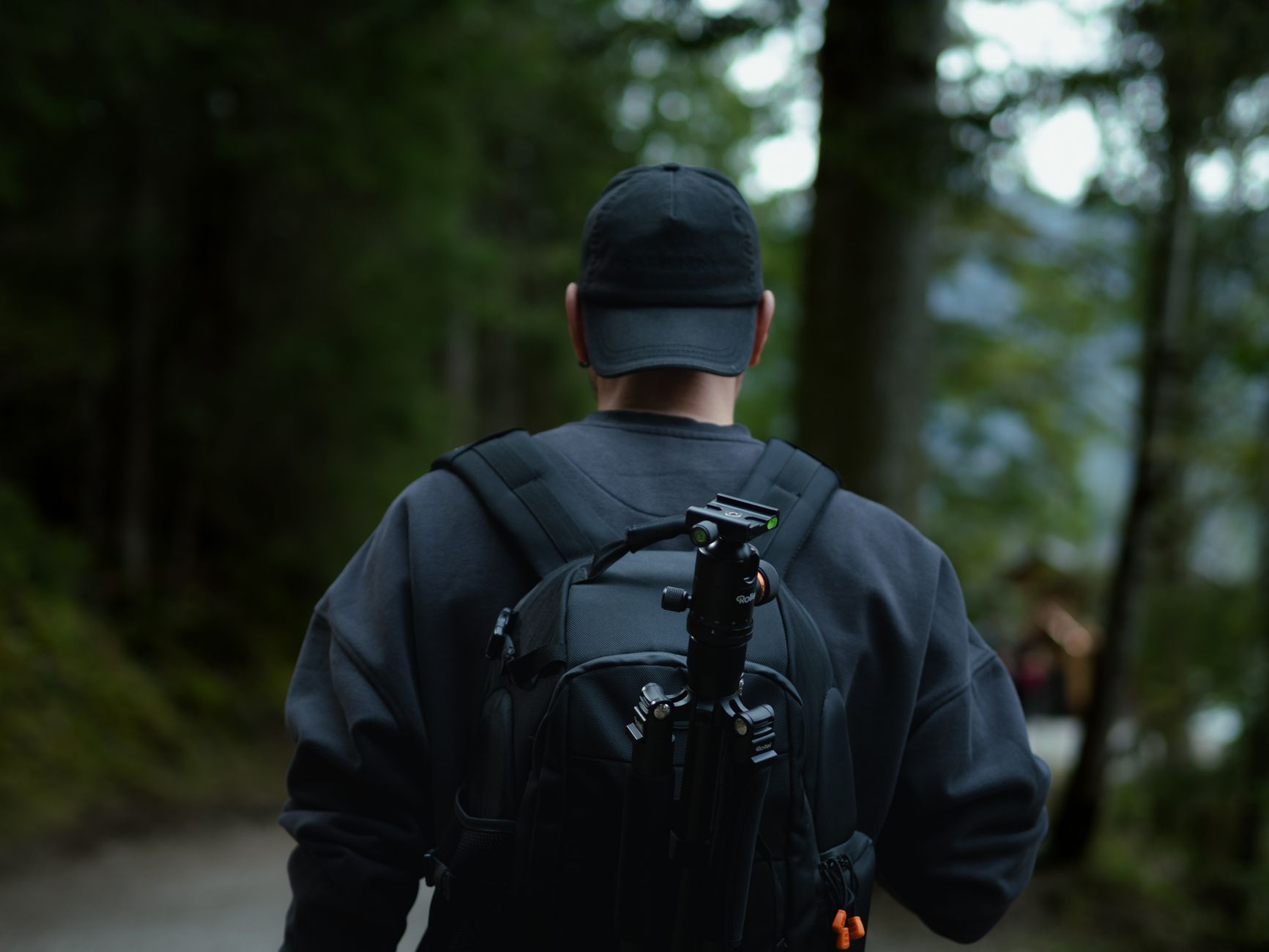
- Use external compression straps on a camera backpack to keep the tripod accessible and within bag weight limits
- Use a padded tripod sleeve to prevent rattling and protect legs in overhead bins
- If the tripod exceeds carry-on limits, ask the airline whether it qualifies as oversized sporting equipment
General international carry-on guidance from the International Air Transport Association is a useful baseline, but individual carriers set their own limits — some low-cost airlines are significantly stricter.
⚠️ No Tripod Is Guaranteed Carry-On Compliant With Every Airline > > Airline carry-on dimensions and policies differ across carriers, routes, and aircraft, and rules change. No specific tripod can be guaranteed carry-on compliant everywhere. Treat IATA dimensions as a general guideline only and confirm with your airline before each trip.
How to Attach a Tripod to a Camera Backpack
Most camera backpacks offer two attachment options: a dedicated side sleeve with compression straps, or external lash points on the back panel. The side sleeve is faster to deploy mid-hike; the back-panel position balances weight more evenly for long carries.
A practical rule: keep the tripod attached externally while hiking, but stow it internally (or compress it tight to the pack) when going through airport security or boarding. An externally strapped tripod adds to your bag's perceived size, and some gate agents will flag it even if it's within limits.
<a id="evaluation-approach"></a> ## How We Evaluated These Tripods
Photography Launchpad guides are research-based, not hands-on reviews. Here's exactly how we built this one — so you can judge whether the picks hold up for your use case.
💡 Editorial Independence > > Photography Launchpad uses affiliate links where applicable. This does not influence our editorial rankings. Every pick in this guide is based on the evaluation criteria below, and we recommend cheaper options when they're genuinely better for a given use case.
Our Evaluation Criteria
- Specifications cross-referenced with current manufacturer product pages to ensure weight, height, folded length, and load capacity data are accurate as of 2026
- Price ranges researched across major retailers rather than quoted as point prices, since prices fluctuate weekly
- Use-case alignment: each tripod evaluated against the specific demands of hiking, landscape long exposure, video, and budget travel
- Community and expert consensus reviewed across established publications including DPReview and PetaPixel, plus active photography community forums
- Dual metric and imperial units applied throughout to serve an international audience
- Content gap analysis used to prioritize underserved topics — video head selection, airline carry-on reality, and budget-tier guidance that most guides skip
<a id="faq"></a> ## Frequently Asked Questions About Travel Tripods
Do I really need a travel tripod?
If you shoot in low light, want sharp long exposures, do landscape or night photography, or need self-portraits on the road, a travel tripod earns its weight on every trip. Casual daylight shooters can often get by with a smaller GorillaPod or a tabletop tripod. The honest question: does image sharpness or creative control in difficult light actually matter for the work you want to make?
Is carbon fiber or aluminum better for a travel tripod?
Carbon fiber is lighter and damps vibration better, making it the preferred choice for weight-conscious travelers and long-exposure photographers. Aluminum is heavier but significantly cheaper and still delivers solid stability for most situations. If your budget allows, carbon fiber is worth the upgrade. If not, a quality aluminum tripod will serve you well for years.
What is the best lightweight travel tripod under 1 kg?
Several carbon fiber travel tripods come in under 1 kg (2.2 lb), including the Sirui T-0S and certain lightweight configurations from other brands — verify current weight specs on manufacturer pages, since models update. At this weight class, expect trade-offs in maximum height or load capacity compared with heavier alternatives.
Can a travel tripod be used for video and vlogging?
Yes, with one important caveat: most travel tripods ship with a ball head, which doesn't produce the smooth panning motion video needs. For vlogging and video, look for a tripod that accepts an aftermarket fluid head, or choose a flexible-joint tripod like the Joby GorillaPod for creative angles. A dedicated fluid head adds 200–500 g (0.4–1.1 lb) but dramatically improves video quality.
Will my travel tripod fit as carry-on luggage?
Most travel tripods with a folded length under 45 cm (17.7 in) will fit within common carry-on size allowances, but no tripod is guaranteed compliant with every airline. Carry-on rules vary by carrier and change over time — always check your specific airline's current policy before flying. Remove spike feet and pack them separately to avoid security delays.
What load capacity do I need for a mirrorless or DSLR camera?
Add your heaviest camera body and heaviest lens together, then pick a tripod rated at least twice that figure. Manufacturer load ratings are maximum theoretical capacities, not safe working weights — real-world stability is lower, especially in wind. For a typical full-frame mirrorless plus a mid-range zoom (roughly 1.5–2 kg / 3.3–4.4 lb combined), aim for a tripod rated 5–8 kg (11–17.6 lb) or more.
How many leg sections should a travel tripod have?
Four or five leg sections offer the most compact folded length for a given max height, which is ideal for travel. Three-section tripods are more rigid since each joint is a potential flex point, but they fold longer. For most travel photographers, four-section legs hit the best balance of packability and stability.
What is the difference between a ball head and a pan-tilt head?
A ball head uses a single ball joint you unlock, reposition in any direction, and re-lock — fast and compact, the standard for stills travel photography. A pan-tilt head has separate controls for each axis (tilt, pan, side tilt) for precise incremental adjustments — better for architecture, studio work, and video, but heavier and slower. Most travel tripods use ball heads for a reason.
Sources
- Peak Design Travel Tripod — Official Product Page
- Gitzo Series 1 Traveler — Official Product Page
- Manfrotto Befree Advanced — Official Product Page
- Sirui Tripods — Official Collection Page
- 3 Legged Thing — Travel Tripods Collection
- IATA Passenger Baggage — International Air Transport Association
- Really Right Stuff — Technical Resources
- DPReview — Tripod and Support Category
- B&H Explora — How to Choose a Tripod
- PetaPixel — Photography News and Gear Reviews