What does it actually take to start a photography business legally and profitably in 2026?
Quick answer: Starting a photography business in 2026 requires registering your business legally (typically as an LLC or sole proprietor), investing in reliable gear and editing software, building a portfolio, setting clear pricing, and marketing to your first clients. Most beginners can launch a legally compliant, client-ready business for roughly $1,000–$5,000 depending on location, gear choices, and niche — though costs vary widely. The key is following a repeatable step-by-step process rather than trying to perfect everything before booking your first session.
Learn how to start a photography business step by step: legal setup, gear, pricing, contracts, and how to land your first clients — practical advice for beginners in 2026.
Last Updated: 2026
I'm Marcus, and I built a six-figure photography business after burning roughly $2,000 in my first year on gear and software I didn't need. This guide is the playbook I wish someone had handed me before I wasted that money. Here's the reality — most of what new photographers worry about (which camera, which preset pack, which website builder) matters far less than the boring stuff: registering legally, writing real contracts, and knowing how to price a session so you don't go broke.
Key Takeaways
- Register your business legally before booking paying clients — an LLC can help separate personal and business assets.
- You can start with a used camera body and one quality lens; upgrade gear as revenue grows.
- Build your portfolio first with free or styled shoots before charging full rates.
- Price your services using a cost-of-doing-business formula, not by copying competitors.
- Every paid booking needs a written contract and at minimum a general liability insurance policy.
- Instagram, Google Business Profile, and referrals are the most cost-effective channels for early client acquisition.
- Startup costs commonly range from $1,000 to $5,000 but vary significantly by state, city, and equipment choices.
What Is a Photography Business (and Is It Right for You)?
A photography business is any operation where you exchange photography services for money — whether that's a $200 family mini-session or a $5,000 wedding. The moment money changes hands, you're running a business in the eyes of the IRS, your state, and your city.
Is a photography business worth starting? Yes, if you treat it like a business and not an expensive hobby. According to the U.S. Bureau of Labor Statistics, the median annual wage for photographers sits in the mid-$40,000s range, but self-employed photographers in specialty niches (weddings, commercial, branding) regularly earn well above that. Income varies widely based on niche, location, and how seriously you market.
I've tested this personally across both wedding and commercial work over eight years. The photographers who succeed aren't the most technically gifted. They're the ones who answer emails fast, write clear contracts, and know their numbers.
💡 Realistic Expectations > > Most photographers grow their client base over several months, not days. Treat your first 5–10 bookings as portfolio-building opportunities even if profit margins are thin. The compounding effect of referrals doesn't kick in until you've delivered consistent work to enough happy clients.
Types of Photography Niches to Consider
Your niche shapes your gear list, pricing ceiling, and competition. The most common entry points:
- Portrait/family — low gear barrier, steady demand, moderate pricing.
- Newborn — specialized skill (and safety training) required, premium pricing.
- Wedding — highest income potential per booking, also highest stress and gear requirements.
- Commercial/branding — corporate clients, recurring contracts, requires business polish.
- Real estate — fast turnaround, volume-based, needs wide-angle lens and basic flash.
- Events — corporate parties, conferences, sports leagues.
- Stock — passive income, but the per-image payout is tiny.
Pick one primary niche for your first year. A focused portfolio of 15 newborn images converts more newborn inquiries than a scattered mix of weddings, pets, and headshots. You can always expand later — niche choice isn't a tattoo.
Hobby vs. Business: When Does Photography Become a Business?
The IRS treats hobby income and business income differently, and the line is thinner than most beginners assume. If you're regularly accepting money — even cash from friends — you likely have a tax filing obligation. The IRS Self-Employed Individuals Tax Center lays out when self-employment tax kicks in.
Here's the honest version: if you're charging anyone for photography, register properly from day one. Operating informally exposes you to tax penalties and leaves your personal assets unprotected if a client ever sues. Going legit also signals professionalism to clients — most won't hire a "photographer" who can't issue a real invoice.
Step-by-Step: How to Start a Photography Business
Here's the 9-step process I'd follow if I were starting over today:
- Choose your business name and confirm domain availability.
- Register your business legally with your state (sole proprietor, LLC, etc.).
- Open a dedicated business bank account using your EIN.
- Buy or confirm your camera body and essential lenses — used is fine.
- Set up editing software and a 3-2-1 backup system before your first paid shoot.
- Build your portfolio through free or styled sessions targeting your chosen niche.
- Launch a simple website with a pricing page and contact form.
- Get a written contract template and general liability insurance.
- Market your services through Google Business Profile, Instagram, and referrals — and book your first paid session.
✅ Photography Business Quick-Start Checklist
- Choose your business name and confirm domain availability
- Register your business legally with your state and/or city
- Open a dedicated business bank account
- Purchase or confirm your camera body and essential lenses
- Set up editing software and a file backup system
- Shoot free or styled sessions to build your portfolio
- Launch a simple website with a pricing page and contact form
- Obtain a written client contract template and business insurance
- Create social media profiles and a Google Business Profile
- Book and deliver your first paid session
💡 Don't Wait Until Everything Is Perfect > > A focused portfolio of 10–15 strong images and a legally registered business is enough to start booking clients. I've watched too many aspiring photographers spend two years "getting ready" while a less talented friend with worse gear builds a six-figure book by just starting. Done beats perfect.
Legal Setup: Registering Your Photography Business
This is where most new photographers either freeze up or skip steps entirely. Don't. The legal foundation is what separates a real business from an expensive hobby that the IRS will eventually notice.
Do you need a license to be a photographer? In most U.S. jurisdictions, you need a general business license to operate commercially — not a photography-specific license. Requirements and fees vary significantly by state and city. Check your local Secretary of State website and city/county business office to confirm what applies where you live.
Let's break down the actual entity choices.
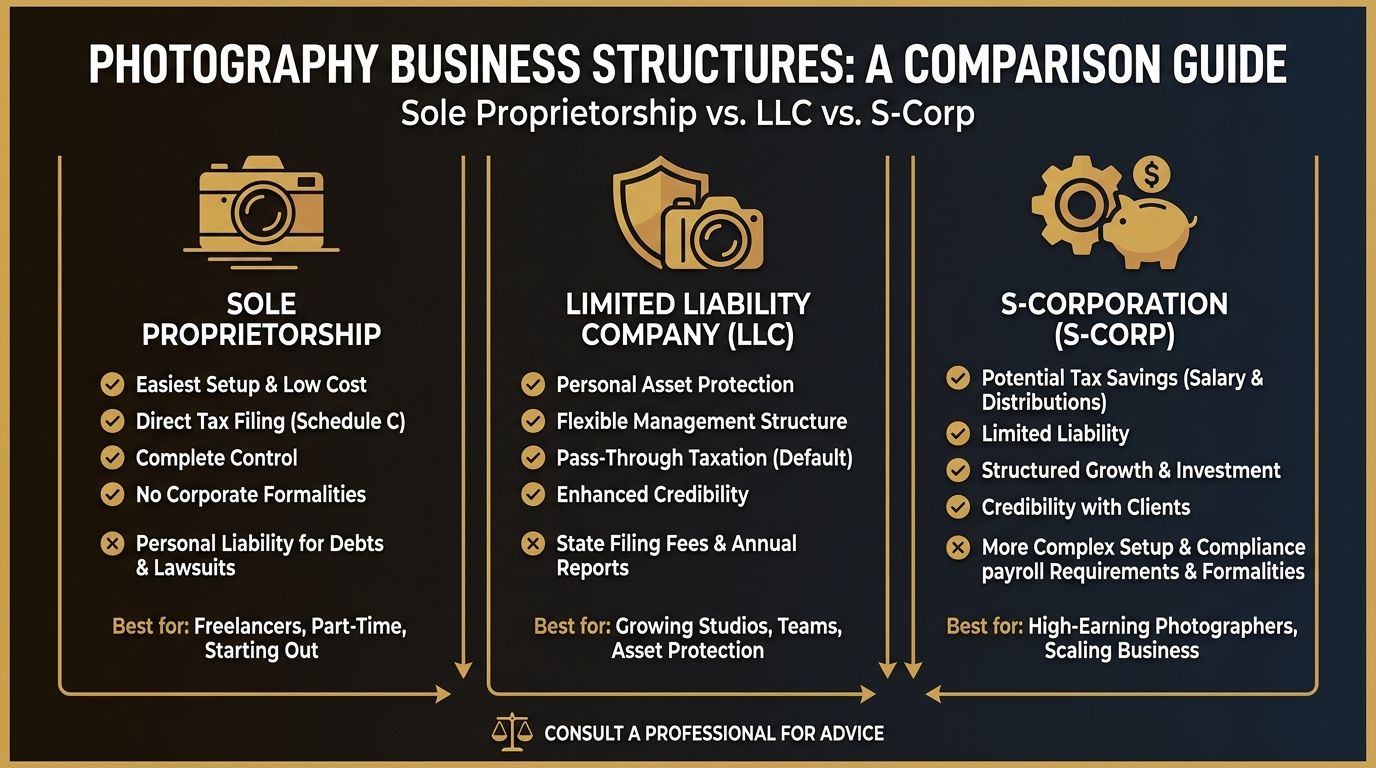
Business Entity Comparison for Photographers
| Entity Type | Liability Protection | Tax Treatment | Setup Cost (Typical Range) | Best For |
|---|---|---|---|---|
| Sole Proprietor | None — personal and business assets are legally the same | Reported on personal return (Schedule C); self-employment tax applies | $0–$100 (DBA filing if needed) | Hobbyists testing paid work; lowest barrier |
| Single-Member LLC | Can help separate personal and business assets, with state-specific limits | Default: pass-through to personal return; can elect S-Corp status | $50–$500 LLC filing fee; varies by state, plus annual/biennial reports | Most beginning professional photographers |
| S-Corp Election | Same legal protection as LLC; potential self-employment tax savings | Pass-through with reasonable salary requirement; more complex filings | $50–$500 setup plus ongoing CPA/payroll fees | Established photographers earning $60K+ profit |
⚠️ Disclaimer: Legal and Tax Advice Varies > > Registration requirements, fees, and tax obligations vary significantly by state and city. Always verify with your local Secretary of State website and consult a licensed CPA or attorney before making entity decisions. This article is general guidance, not legal advice.
✅ Legal Registration Checklist
- Choose a business name (check your state's business name database)
- Verify domain name availability for your chosen name
- Register as a sole proprietor, LLC, or other entity with your state Secretary of State — see the SBA's business registration guide
- Obtain a city or county business license if required in your jurisdiction
- Apply for an EIN (Employer Identification Number) via IRS.gov — free
- Register for sales tax collection if your state taxes photography services
- Open a business checking account using your EIN
- Consult a CPA or business attorney for state-specific guidance
LLC vs. Sole Proprietorship: Which Is Better for Photographers?
A sole proprietorship is the default. If you accept money for photography and haven't filed any paperwork, you already are one. It's simple, but there's zero separation between you and the business — if a client sues you, your personal savings, car, and home are on the table.
A single-member LLC can help establish a legal boundary between personal assets and business liabilities. I say "can help" because LLC protection isn't absolute — it depends on your state's laws and whether you maintain it properly (separate bank account, no commingled funds, signed contracts in the business name). Talk to an attorney about how it actually works in your jurisdiction.
LLC filing fees commonly range from $50 to $500 depending on the state, with some states also charging biennial report fees. For most new photographers, an LLC is a reasonable starting structure. An S-Corp election can make tax sense later once you're netting $60,000+ in profit — but that's a conversation for a CPA, not a blog post.
Do Photographers Need a Business License?
Most cities and counties require a general business operating license to work commercially within their jurisdiction. A few things to check:
- Some states require state-level registration; some cities require their own permit on top.
- If you shoot weddings or events across multiple cities or states, you may need to verify requirements in each location.
- Photography services are taxable in some states (sales tax applies to digital files, prints, or the full session fee) and not in others. Check your state's department of revenue.
- The SBA business registration guide and your state's Secretary of State website are the two most reliable starting points.
For free mentoring on entity setup and business planning, SCORE (an SBA resource partner) offers volunteer business advisors at no cost.
Gear Essentials: What Equipment You Actually Need
I've tested this personally across roughly a dozen camera bodies in eight years. Here's what I'd tell you over coffee: you don't need a $4,000 flagship, you need a reliable camera and one excellent lens.
Beginner Camera Comparison (2026)
| Camera Body | Brand | Sensor Type | Approx. Price Range (New) | Best For |
|---|---|---|---|---|
| Sony a6700 | Sony | APS-C mirrorless | $1,300–$1,500 | Hybrid photo/video, portraits, events |
| Canon EOS R10 | Canon | APS-C mirrorless | $900–$1,100 | Portraits, family sessions, all-around starter |
| Nikon Z fc / Z 50 II | Nikon | APS-C mirrorless | $900–$1,200 | Lifestyle, travel, portrait |
| Fujifilm X-S20 | Fujifilm | APS-C mirrorless | $1,200–$1,400 | Color science lovers, branding, weddings |
| Canon EOS R8 | Canon | Full-frame mirrorless | $1,400–$1,700 | Photographers ready for full-frame on a budget |
Verify current specs and pricing on DPReview or the manufacturer's site — prices shift constantly. Used and manufacturer-refurbished bodies can cut these numbers by 30–50%.
✅ Minimum Viable Gear List
- One reliable camera body (mirrorless preferred for 2026)
- One versatile prime or zoom lens (50mm f/1.8 or 24–70mm f/2.8)
- At least two memory cards (redundancy is non-negotiable for paid work)
- A sturdy camera bag for transport and protection
- At least one external backup drive for file storage
- A basic reflector for natural light control (optional but cheap)
💡 Buy Used, Upgrade Later > > Buying a used camera body from a reputable seller — manufacturer-certified refurbished, or established platforms like KEH or MPB — can cut upfront costs by 30–50%. Focus early investment on lenses. Glass holds value better than bodies and impacts image quality more.
Lenses Matter More Than Camera Bodies
Here's a rule I wish someone had drilled into me sooner: cameras are tools that depreciate; lenses are investments that hold value. A 50mm f/1.8 ("nifty fifty") costs under $200 in most systems and produces images that look more "professional" than what you'd get with a $3,000 body and the kit zoom that came with it.
For event and wedding work, a 24–70mm f/2.8 zoom is the workhorse — but it's expensive ($1,000–$2,500 new). Rent one for your first few weddings before committing. Lenses also transfer when you upgrade bodies within the same system, so the money isn't wasted.
Gear You Do NOT Need to Start
You don't need a $3,000 flagship body, you need one solid kit. Skip these on day one:
- The latest flagship camera body (the previous generation is 95% as good for half the price)
- A full studio strobe kit (use natural light or a single speedlight)
- Two camera bodies (rent a backup for weddings instead)
- A drone (unless you're shooting real estate or landscape)
- Specialty lenses (macro, tilt-shift) until a paying client needs them
Reinvest revenue into gear upgrades — don't finance gear hoping bookings show up.
Editing Software and Workflow Tools
Editing Software Comparison for Photographers
| Software | Monthly Cost (Approx.) | Learning Curve | Best For | Free Trial? |
|---|---|---|---|---|
| [Adobe Lightroom Classic](https://www.adobe.com/products/photoshop-lightroom.html) (Photography Plan) | ~$10–$15/mo | Moderate | Industry standard; portraits, weddings, events | Yes (7 days) |
| Capture One Pro | ~$25/mo or perpetual license | Steeper | Studio, commercial, tethered shooting | Yes (30 days) |
| Luminar Neo | ~$10–$15/mo or one-time | Easy | AI-assisted edits, beginners | Yes |
| RawTherapee / darktable | Free | Steep | Budget starters willing to learn | N/A (open source) |
For 99% of new photographers, Adobe Lightroom Classic on the Photography Plan is the right call. It's what most clients' files end up in, what every tutorial is built around, and it integrates with Photoshop for retouching.
⚠️ The Non-Negotiable: Backup Everything > > Losing a client's images is one of the most damaging things that can happen to a new photography business. Follow the 3-2-1 backup rule: 3 copies of every file, on 2 different media types, with 1 copy offsite or in the cloud. I learned this the hard way when a hard drive died with two weeks of unedited family sessions on it. Backups aren't optional.
Gallery Delivery and Client-Facing Tools
Sending clients a Google Drive link screams amateur. Use a purpose-built gallery platform:
- [Pixieset](https://helpdesk.pixieset.com/hc/en-us/articles/360017576251) — free tier available, clean galleries, print store built in
- Pic-Time — strong print sales automation, popular with wedding photographers
- ShootProof — flexible pricing, client proofing tools
These platforms double as simple portfolio sites for beginners and most include print lab integrations that create passive revenue. A client buying a $300 canvas from your gallery is found money.
Business Management and CRM Tools
Once you're booking more than 2–3 clients a month, admin work eats your weekends. The two industry standards:
- HoneyBook — easier interface, popular with wedding/family photographers
- Dubsado — more customizable, popular with commercial/branding photographers
Both offer free trials and run roughly $25–$50/month depending on plan and billing cycle. Before investing, Google Workspace (Gmail + Calendar + Drive) plus a simple invoicing tool like Wave or Square is plenty. One quick win: get a custom email address ([email protected]) instead of a Gmail address. It costs $6/month and clients notice.
How to Build a Photography Portfolio from Scratch
If you want to actually book paying clients, you need a portfolio of work that looks like what those clients want to buy. Not your best landscapes from that Iceland trip — work that matches your niche.
How to build a photography portfolio with no clients:
- Choose your target niche and the type of work you want to be paid for.
- Run 3–5 free portfolio sessions with friends, family, or models who fit your ideal client profile.
- Collaborate on styled shoots with local florists, makeup artists, and stylists.
- Shoot personal projects that demonstrate your point of view.
- Edit ruthlessly — only keep images you'd be excited to recreate for a paying client.
- Curate 10–15 best images rather than displaying everything.
💡 Quality Over Quantity > > A portfolio of 12 exceptional, cohesive images will convert more inquiries than a gallery of 60 average ones. Edit ruthlessly. If you wouldn't be excited to recreate the shot for a paying client, it doesn't belong in the portfolio.
Free and Styled Shoots: Your Fastest Path to Portfolio Images
A "model call" is a public offer of free or discounted sessions in exchange for permission to use the images in your marketing. Post one on Instagram, Facebook groups, or local community boards. You'll get more applicants than you can handle.
Styled shoots are collaborative sessions where multiple vendors contribute services to create portfolio-quality content. A florist provides arrangements, a makeup artist styles a model, a stylist provides the wardrobe, you shoot it — everyone walks away with images for their portfolio. These are how wedding photographers build polished portfolios without ever shooting a real wedding.
Two rules that matter:
- The session should simulate the exact work you want to be paid for. Free family sessions if you want to book family work. Don't shoot a free engagement session if your goal is corporate headshots.
- Get a written model release even for free sessions. A model release is a legal document giving you permission to use someone's likeness in marketing. Build the habit before it matters legally.
Where to Display Your Portfolio
- A dedicated website is the primary portfolio home. You own the URL, you control the SEO, and you can integrate contact forms and pricing.
- Instagram is where most potential portrait, family, and wedding clients first see you. Treat it as a visual portfolio.
- Pinterest drives long-tail search traffic, especially for wedding and family photography. Underused by most photographers.
- Facebook is fine for community engagement but its image compression and limited organic reach make it a weak primary portfolio.
How to Price Your Photography Services
This is where most new photographers go wrong. They look at a competitor's website, undercut by 20%, and end up making $8/hour after expenses. Don't do that.
How to price photography services: Use the cost-of-doing-business (CODB) formula: take your total annual business expenses, add your desired annual salary, and divide by the number of sessions you can realistically book in a year. The result is your minimum price per session — a floor, not a ceiling. Market rates, niche, and perceived value determine where you go above that floor.
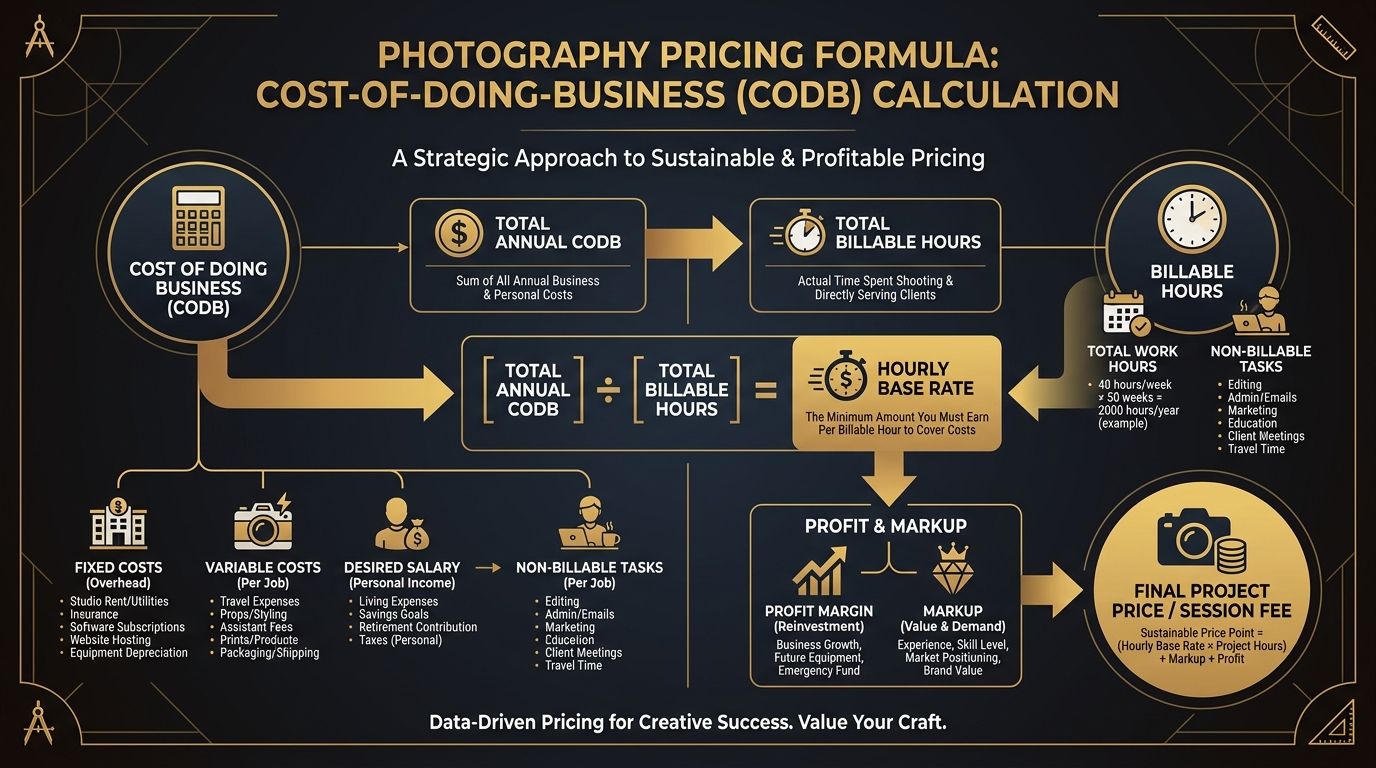
The Cost-of-Doing-Business (CODB) Formula
CODB = total annual expenses required to run your business. That includes:
- Gear depreciation and replacement
- Software subscriptions (Lightroom, gallery platform, CRM)
- Insurance (general liability + equipment)
- Marketing (website hosting, ads, branding)
- Education (workshops, courses, conferences)
- Mileage, parking, travel
- Self-employment taxes
- Business registration and accounting fees
The formula:
(Annual CODB + Desired Annual Income) ÷ Number of Sessions You Can Book Per Year = Minimum Price Per Session
Illustrative example only (your numbers will vary): If your CODB is $12,000, you want to take home $40,000, and you can realistically book 50 sessions a year, your minimum session price is ($12,000 + $40,000) ÷ 50 = $1,040/session. That's your floor. If you're charging $300 per family session "because everyone in town charges that," you're losing money.
The Professional Photographers of America (PPA) publishes industry benchmark studies for members — worth a look once you're serious.
⚠️ The Danger of Underpricing > > Pricing too low signals low quality to potential clients AND makes it impossible to cover real business expenses. Use the CODB formula to establish a floor — never price below what it costs you to operate.
Sample Photography Pricing Tiers by Niche (Illustrative Ranges)
| Photography Niche | Typical Starter Range | Mid-Level Range | Notes |
|---|---|---|---|
| Portrait/Family | $150–$400/session | $400–$1,200/session | Includes 1–2 hours + edited gallery |
| Newborn | $300–$600/session | $600–$1,500/session | Specialized; usually in-home or studio |
| Wedding | $1,500–$3,500 | $3,500–$8,000+ | Full-day coverage; second shooter extra |
| Commercial/Branding | $500–$1,500/half-day | $1,500–$5,000+/day | Licensing fees affect pricing |
| Real Estate | $150–$300/listing | $300–$600/listing | Volume-based; faster turnaround |
These are illustrative industry ranges only. Local market rates vary significantly — a wedding photographer in rural Ohio and one in Manhattan operate in different economies.
💡 Don't Forget to Budget for Taxes > > As a self-employed photographer, you owe self-employment tax in addition to income tax. A common planning estimate is to set aside 25–35% of every payment for taxes, but your actual obligation depends on income, entity type, deductions, and state. Make quarterly estimated tax payments and consult a CPA — the IRS Self-Employed Tax Center is the official starting point.
Packages vs. À La Carte Pricing
Packages convert better than à la carte menus. Three reasons:
- They simplify the client's decision — three clear options, not a 20-line menu.
- They increase average order value by bundling prints, albums, or additional time.
- They make your business easier to operate.
For beginners, start with 2–3 simple packages (entry, mid-tier, premium). Display them on your website. Hiding prices behind "contact for pricing" attracts price-shoppers and wastes your time.
Contracts, Insurance, and Client Onboarding
This is the section most beginner guides skip. It's also the one that will save your business when something goes wrong — and something always goes wrong.
What should be in a photography contract:
- ✅ Client and photographer legal names and contact information
- ✅ Session date, time, location, and duration
- ✅ Deliverables: number of edited images, file formats, delivery method and timeline
- ✅ Payment terms: total fee, deposit amount (non-refundable), and balance due date
- ✅ Cancellation and rescheduling policy
- ✅ Model and property release (or explicit limitation on usage rights)
- ✅ Image licensing terms: who can use the images and how
- ✅ Force majeure or circumstances-beyond-control clause
- ✅ Limitation of liability clause (consult an attorney for enforceability in your state)
⚠️ Use a Contract for Every Booking — No Exceptions > > A handshake agreement is not protection. Even free portfolio sessions should include a model release. Consider buying a professionally written contract template from a photography attorney or service like The Legal Paige rather than relying on DIY templates. The $200–$400 you spend on a real contract template will pay for itself the first time you need to enforce it.
Photography Insurance Types Overview
| Insurance Type | What It Covers | Who Needs It | Typical Annual Cost Range |
|---|---|---|---|
| General Liability | Bodily injury or property damage to third parties during sessions | Every working photographer | $150–$500/year |
| Equipment / Inland Marine | Theft, damage, or loss of camera gear | Anyone with gear worth more than they can afford to replace | $200–$600/year |
| Professional Liability (E&O) | Errors, omissions, missed deliverables | Wedding, commercial, contract-heavy work | $300–$700/year |
| Auto (Commercial) | Vehicle use for business — gear transport | If you drive to sessions regularly | Varies; check with auto insurer |
Premiums vary by coverage level, location, and insurer. Get quotes from multiple providers. The PPA member insurance program and Hiscox are two common starting points.
Do Photographers Need Insurance?
Yes. At minimum, you need general liability insurance. Here's why:
- If a client trips over your light stand and breaks an ankle, you're personally liable without it.
- Many venues — especially wedding venues — require proof of general liability insurance (usually $1M coverage) before letting you shoot there.
- Equipment insurance is separate. Your homeowner's policy excludes professional gear in almost every case.
I've tested this personally — when a wedding venue requested my COI (certificate of insurance) two weeks before the wedding, having coverage already in place meant I didn't lose the booking.
A Simple Client Onboarding Workflow
- Respond to inquiry with pricing and availability within 24 hours.
- Send contract and deposit invoice via your CRM or email.
- Confirm the booking once the signed contract and deposit are received.
- Send a pre-session prep guide (what to wear, where to park, what to expect).
- Deliver the edited gallery within the timeline stated in your contract.
- Follow up after delivery to request a Google review and ask for referrals.
That workflow is what separates "person with a camera" from "professional." Clients notice every step.
How to Get Your First Photography Clients
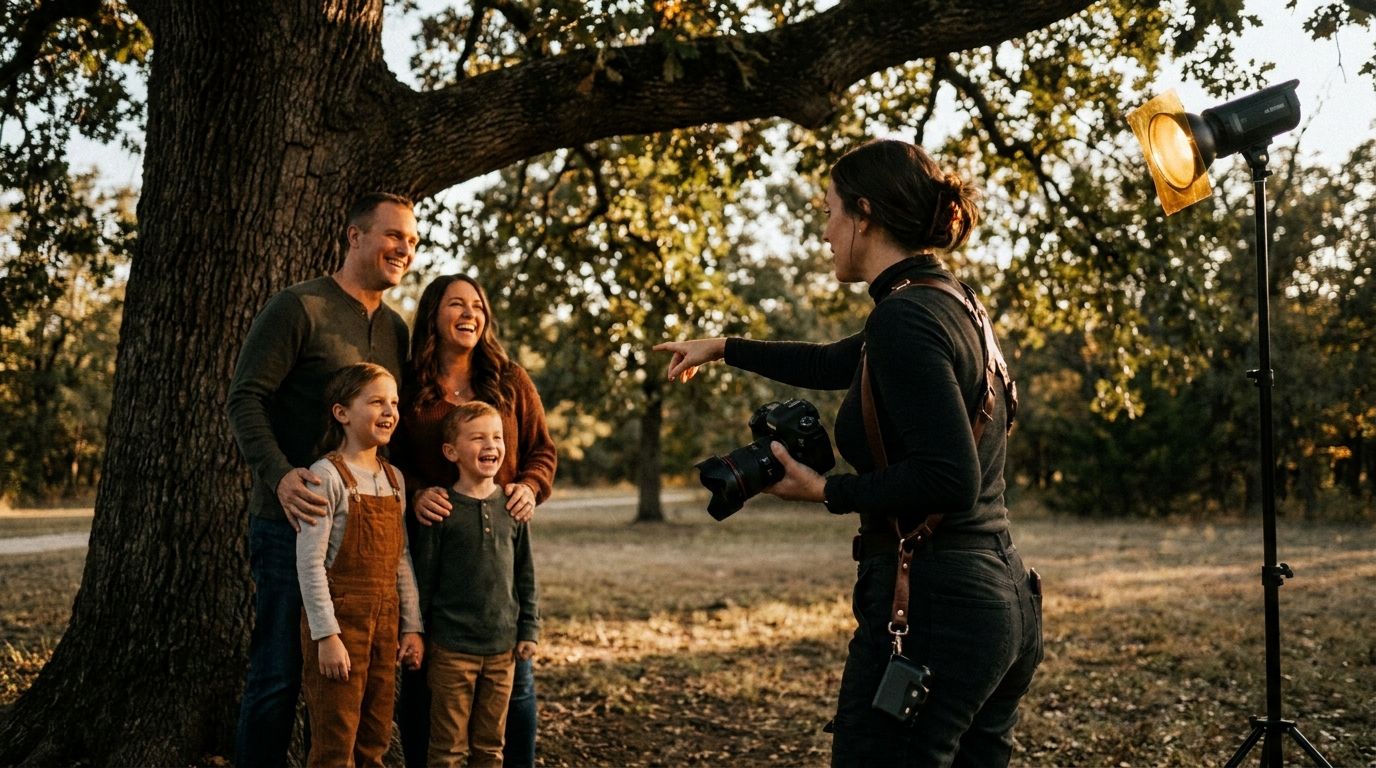
The real reason why most new photographers can't get clients isn't gear or skill — it's that they're invisible. Nobody knows they exist. Here is the fix ↓ one step at a time.
How to get your first photography clients:
- Create and verify a Google Business Profile — free and improves local search visibility.
- Post consistently on Instagram with location-specific hashtags and geotags.
- Announce your launch to your personal network via email and social media.
- Offer a limited introductory rate or free portfolio session to 2–3 ideal clients.
- Build referral partnerships with local wedding planners, florists, and venues.
- Be active in local Facebook groups where your target clients spend time.
- Ask every satisfied client for a Google review and a referral.
✅ First 10 Clients Action Plan
- Create and verify your Google Business Profile
- Post 3x per week on Instagram using location-specific hashtags and tags
- Announce your launch to your personal network via email or social media
- Offer a limited-time introductory rate or free portfolio session to 2–3 ideal clients
- Contact local wedding planners, florists, and venues about referral partnerships
- Join local Facebook groups and community forums where your target clients spend time
- Ask every satisfied client for a Google review and a referral
- Optimize your website homepage and About page for "[city] + [niche] photographer"
💡 Referrals Are Your Most Powerful Early-Stage Channel > > A personal recommendation from a satisfied client is more persuasive than any ad. Prioritize over-delivering for your first few clients — they become your most effective unpaid marketing team. My first wedding referral led to four more bookings over 18 months without me spending a dollar.
Local SEO: Getting Found on Google
Most clients search "[city] photographer" or "[city] wedding photographer" before they ever browse Instagram. If you're not in those results, you don't exist to them.
Steps that move the needle:
- Set up and fully optimize a Google Business Profile. Add categories, services, business hours, and 10–20 high-quality photos. Collect reviews aggressively.
- Optimize your website homepage and service pages with your city and niche in titles, headings, and meta descriptions ("Portland family photographer," not just "Marcus Chen Photography").
- Build local citations — consistent NAP (name, address, phone) on Yelp, WeddingWire, The Knot, and other directories.
- Collect Google reviews — they directly affect local pack rankings.
Social Media: Instagram and Beyond
Instagram is still the dominant visual discovery platform for photographers. Treat the grid as a curated portfolio, not a personal feed.
- Consistency beats volume. 3 high-quality posts per week outperforms 7 mediocre ones.
- Use geotags and location-specific hashtags (#portlandweddingphotographer beats #weddingphotography).
- Tag every collaborator — vendors, models, venues. Their audiences become your audience.
- Pinterest is underused. It drives sustained traffic from long-tail searches, especially for wedding and family work.
- TikTok and YouTube Shorts build brand awareness through behind-the-scenes content. Prioritize where your actual target client spends time — not where you find it easiest to post.
Photography Business Startup Costs: What to Budget
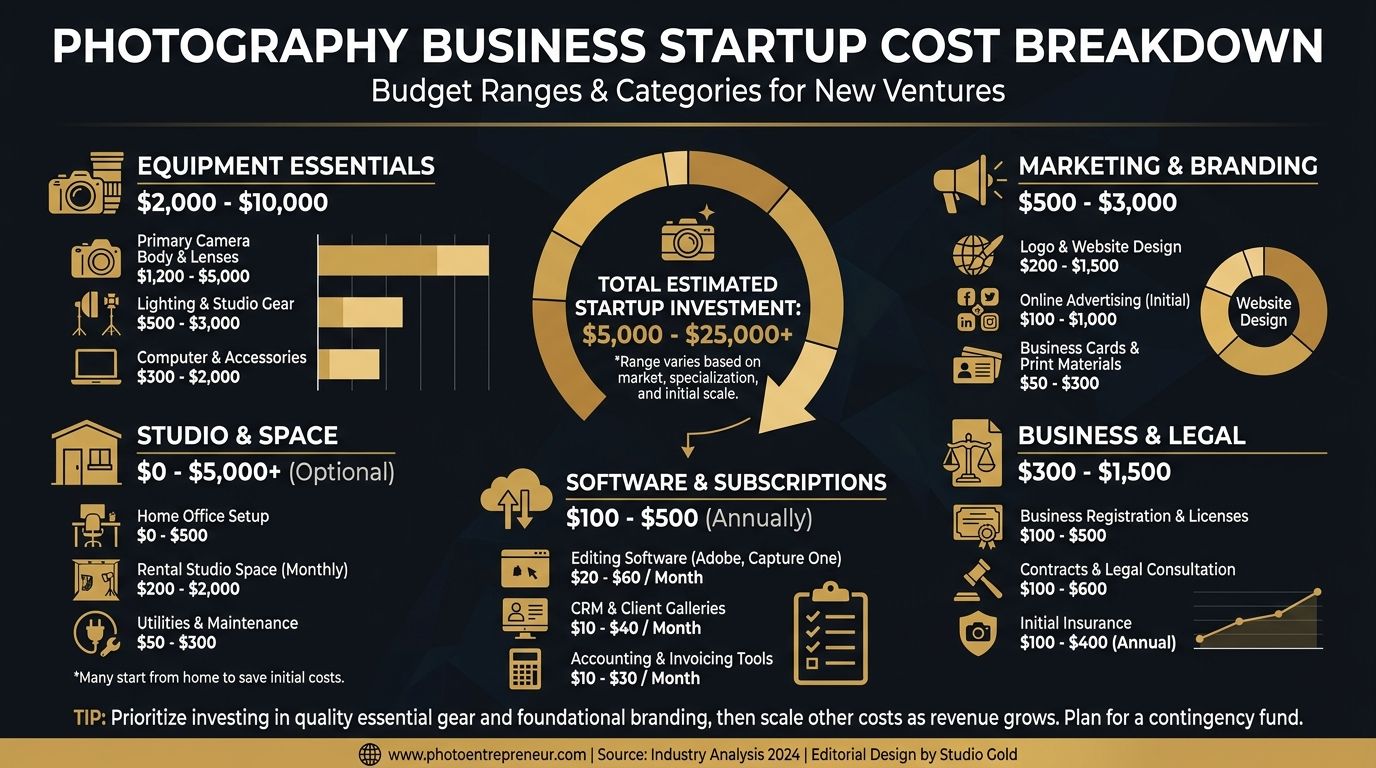
How much does it cost to start a photography business? A lean, legally-compliant photography business commonly costs $1,000–$5,000 to launch. The biggest cost categories are camera gear (body + 1–2 lenses), software subscriptions, business registration and insurance, and website/branding. Costs vary significantly by state, gear choices, and whether you buy new or used.
Photography Business Startup Cost Breakdown
| Cost Category | Budget Option Range | Mid-Range Option | Notes |
|---|---|---|---|
| Camera body | $400–$800 (used) | $900–$1,500 (new) | Mirrorless preferred; used from KEH/MPB saves 30–50% |
| Lens (1–2) | $200–$500 | $600–$1,800 | Prime 50mm to start; add zoom later |
| Memory cards & accessories | $50–$100 | $150–$300 | Minimum 2 cards for redundancy |
| Editing software (annual) | $0 (free options) | $120–$180 (Lightroom plan) | Adobe Photography Plan is industry standard |
| Website & hosting (annual) | $100–$200 | $200–$500 | Squarespace, Showit, or Pixieset free tier |
| Business registration & LLC fees | $0–$100 (sole prop) | $50–$500 (LLC) | Varies by state |
| Business insurance (annual) | $150–$400 | $400–$900 | General liability + equipment coverage |
| Contract template | $0 (DIY — not recommended) | $200–$400 (attorney-drafted) | Use a real template |
| Gallery delivery tool (annual) | $0 (free tier) | $100–$300 | Pixieset, Pic-Time, ShootProof |
| Marketing & branding basics | $50–$200 | $300–$800 | Logo, business cards, initial ads |
All figures are illustrative ranges that vary by location, vendor, and individual choice. LLC fees in particular swing widely by state.
💡 Start Lean and Reinvest Revenue > > You do not need to buy everything at once. Prioritize legal registration, insurance, a real contract, and one solid camera kit. Add CRM software, upgraded gear, and marketing tools as your first bookings generate income. This will pay for itself in your first three bookings if you stay disciplined.
Common Mistakes New Photography Businesses Make
I've made most of these. Save yourself the tuition.
- Underpricing to get bookings → Use the CODB formula to set a floor; raise prices once you've delivered 3–5 successful sessions.
- Skipping the contract → Use a written contract for every booking, including free portfolio sessions (with a model release).
- Buying gear before clients → Book the work first, then upgrade. Rent specialty gear instead of buying.
- No business bank account → Open a dedicated checking account before your first paid session; never commingle funds.
- Trying to shoot every niche → Pick one primary niche for year one; expand once you have a stable client base.
- Ignoring backups → Follow the 3-2-1 rule from day one; losing a wedding gallery will end your business.
- Saying yes to every "exposure" opportunity → Free work is fine if it builds your portfolio in your target niche. It's not fine if it just builds someone else's brand.
Underpricing and Over-Discounting
Charging too little attracts price-sensitive clients who will negotiate every line item, complain about deliverables, and never refer you. Discounting heavily for friends and family creates pricing expectations that follow you for years — the cousin who got a $100 family session will not be paying $600 next year.
Use the CODB formula. Build confidence in your rates by knowing exactly what it costs you to operate.
Skipping the Contract
A handshake doesn't protect you when a client disputes deliverables, refuses to pay the balance, or uses your images in ways you didn't authorize. Even for free sessions, a model release protects your right to use the images in marketing.
A contract also protects clients — it sets clear expectations and builds trust. Professional clients expect one.
Trying to Appeal to Everyone
A portfolio that spans weddings, real estate, pets, and corporate headshots sends a confusing message: this person isn't an expert at anything. Pick one primary niche for your first year. Build a cohesive portfolio. Build a focused referral network in that niche. Expand only once you have a stable book.
Frequently Asked Questions About Starting a Photography Business
How much does it cost to start a photography business?
Starting costs commonly range from roughly $1,000 to $5,000 for a lean setup, covering a used camera kit, editing software, business registration, insurance, and a basic website. Costs vary significantly by state, city, gear choices, and niche. Buying used gear and starting with free-tier tools can keep initial investment toward the lower end of that range.
Do I need a license to start a photography business?
Most U.S. jurisdictions require a general business license to operate a photography business commercially — not a photography-specific license. Some cities require an additional local operating permit. Requirements and fees vary by state and city, so check with your local Secretary of State website and relevant city or county offices to confirm what applies in your area.
Can I start a photography business with no experience?
You can start building toward a photography business with no prior professional experience, but you should invest real time in learning your camera, composition, and lighting before charging clients. Free online courses, YouTube tutorials, and in-person workshops can accelerate skill development. Build a portfolio of free or styled sessions first so potential clients have proof of your abilities.
Is a photography business profitable?
Photography can be profitable, but income varies widely by niche, location, marketing effort, and business management. According to the U.S. Bureau of Labor Statistics, the median annual wage for photographers was in the mid-$40,000s range, though self-employed photographers in specialized niches like weddings and commercial work can earn significantly more. Like any small business, profitability depends on pricing your services correctly and managing expenses.
What camera do I need to start a photography business?
You don't need the latest flagship camera body to start a photography business. A reliable entry-level or mid-range mirrorless camera from Sony, Canon, Nikon, or Fujifilm — new or used — is sufficient for most portrait, family, and event work. Focus your early investment on a quality lens rather than the most expensive body, since lenses have more impact on image quality and hold their value well.
Should I form an LLC for my photography business?
Forming a single-member LLC is a common choice for photographers because it can help establish a legal separation between your personal assets and business liabilities. However, LLC protection has limits and the specifics depend on your state's laws. Consult a licensed attorney or CPA to determine the best entity structure for your situation — what makes sense in one state may differ in another.
How do I get my first photography clients?
The fastest path to your first clients is usually a combination of announcing your launch to your personal network, offering a limited number of introductory or portfolio sessions, creating a Google Business Profile so you show up in local searches, and being active on Instagram with location-specific content. Referrals from satisfied early clients are often the most powerful and sustainable source of new bookings.
Do I need a contract for every photography session?
Yes — a written contract protects both you and your client by clearly defining deliverables, payment terms, cancellation policies, and image usage rights. You should use a contract for every paid booking and a model release for any free session where you plan to use images in your marketing. Consider purchasing a professionally written contract template from a photography-focused attorney rather than using a generic free template.
Sources
- Photographers: Occupational Outlook Handbook — U.S. Bureau of Labor Statistics
- Register Your Business — U.S. Small Business Administration
- Self-Employed Individuals Tax Center — IRS
- Professional Photographers of America (PPA)
- Photography Insurance — Hiscox
- DPReview — Digital Photography Review
- How to Start a Photography Business — PetaPixel
- Getting Started with Pixieset — Pixieset Help Center
- Adobe Lightroom — Official Product Page
- Photography Business Plan Resources — SCORE