
What should a photography business plan include, and how do you write one from scratch?
Quick answer: A photography business plan is a structured document covering your executive summary, services, target market, marketing strategy, operations, and 3-year financial projections. It serves as both a roadmap for running your business and a tool for securing loans or investors. Most plans follow an 8–10 section format and can be completed in a few focused work sessions using a template.
Write a photography business plan step by step with our free template, worked example, sample financials, SWOT analysis, and pricing strategy. Download PDF and Google Docs.
Key Takeaways
- A photography business plan typically has 8–10 sections, from executive summary to financial projections.
- Start with your executive summary last. It's easier once all other sections are written.
- Startup costs for photography businesses vary widely, commonly ranging from $10,000 to $100,000+.
- Include 3-year revenue, profit and loss, and cash flow projections to satisfy lenders.
- A SWOT analysis and risk section strengthen your plan for investors and self-review.
- Pricing should be based on your cost of doing business (CODB), not competitor guesswork.
- Your plan is a living document. Revisit and update it at least once per year.
What Is a Photography Business Plan?
Here's the reality: most photographers are creative professionals first and business planners second. That's exactly why the photographers who actually make a living from their craft are the ones who sit down and write the thing anyway.
A photography business plan is a written document that defines your services, target market, pricing, operations, and 3-year financials. It serves two purposes at once: an internal roadmap for running the business and an external document for securing loans, investors, or partnerships. Most plans run 10–20 pages across 8–10 core sections.
Whether you're shooting newborn portraits from a spare bedroom, launching a wedding studio, or building a commercial brand photography practice, the structure stays the same. What changes is the detail inside each section.
According to the U.S. Bureau of Labor Statistics, a large share of small businesses close within five years of opening. A business plan won't guarantee survival, but it forces you to pressure-test your assumptions before you spend the money.
Tip: Do You Need a Business Plan Even If You Are Not Seeking a Loan? > > Yes. Even self-funded photographers benefit from writing one. The discipline of defining your target client, pricing floor, and growth milestones surfaces blind spots before they become expensive mistakes. If you've never written down your cost of doing business, you probably don't actually know what you need to charge.
Who Should Write a Photography Business Plan?
- Photographers launching their first paying business, whether portrait, wedding, commercial, or product.
- Freelancers transitioning from part-time gigs to full-time professional work.
- Studio owners seeking a bank loan, SBA loan, or outside investment.
- Established photographers rebranding, expanding services, or entering a new niche.
What a Business Plan Is Not
- It's not a portfolio. Keep creative samples in an appendix or separate document.
- It's not a legal contract, though it may reference your standard client contracts.
- It's not a one-time document. Treat it as a living guide you update at least annually.
How the 8-Section Photography Business Plan Framework Works
Before you start writing, get a feel for what you're building. Every strong photography business plan covers the same eight sections:
- Executive summary
- Business overview
- Market analysis
- Services and pricing
- Marketing and sales strategy
- Operations plan
- Financial projections
- Appendices
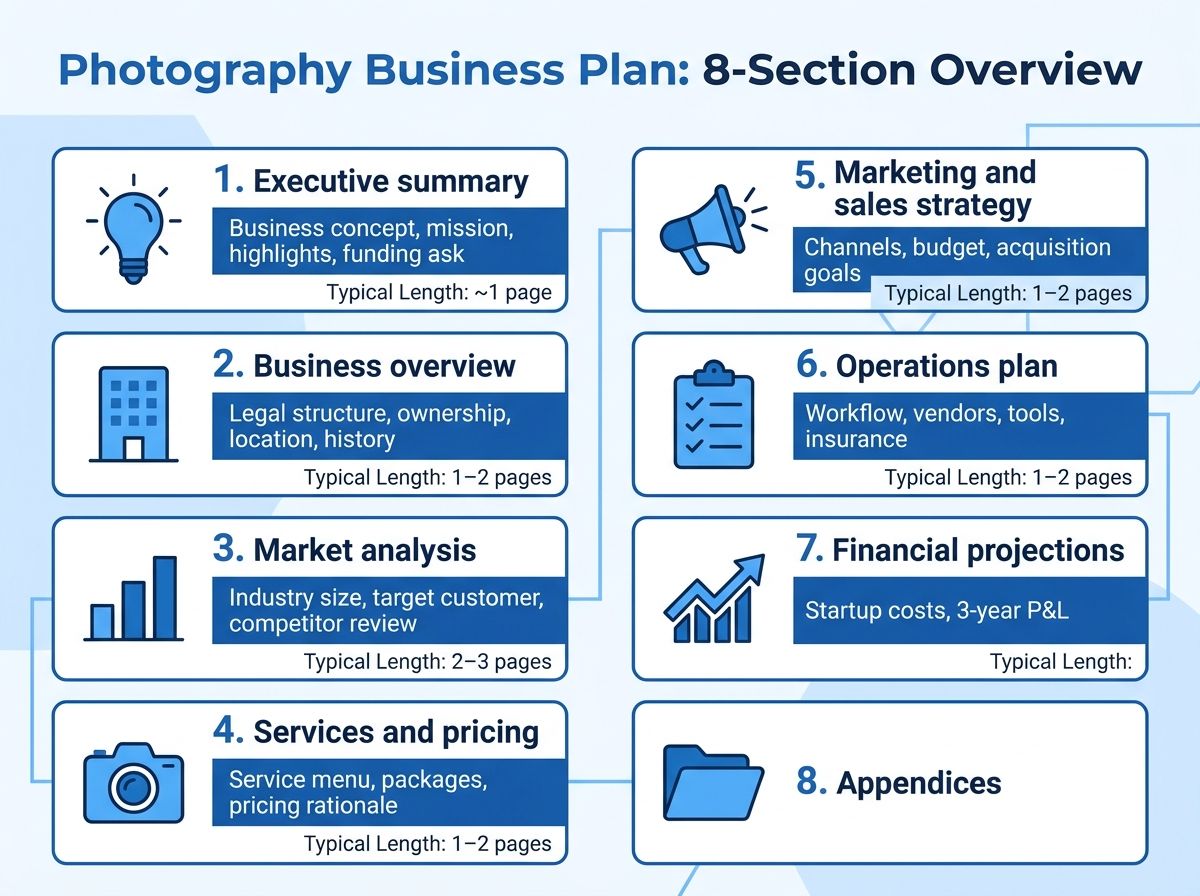
Here's what each section covers and roughly how much space it should take.
Photography Business Plan: 8-Section Overview
| Section | What It Covers | Typical Length |
|---|---|---|
| 1. Executive Summary | Business concept, mission, highlights, funding ask | ~1 page |
| 2. Business Overview | Legal structure, ownership, location, history | 1–2 pages |
| 3. Market Analysis | Industry size, target customer, competitor review | 2–3 pages |
| 4. Services and Pricing | Service menu, packages, pricing rationale | 1–2 pages |
| 5. Marketing and Sales Strategy | Channels, budget, acquisition goals | 1–2 pages |
| 6. Operations Plan | Workflow, vendors, tools, insurance | 1–2 pages |
| 7. Financial Projections | Startup costs, 3-year P&L, cash flow, break-even | 2–4 pages |
| 8. Appendices | Portfolio samples, resumes, licenses, contracts | Varies |
Lengths above are typical guidance. A solo photographer plan can stay at the shorter end. A studio seeking a six-figure loan will land at the longer end.
Tip: Write the Executive Summary Last > > Although it appears first in the final document, the executive summary is easiest to write after every other section is complete. It's a distillation of your plan, not an introduction to it. Draft it last and you'll save yourself three rewrites.
Step-by-Step: How to Write Each Section of Your Photography Business Plan
Here's the process, start to finish:
- Write the Executive Summary (last)
- Describe your business and services
- Conduct market research and competitor analysis
- Define your marketing and sales strategy
- Plan your operations and staffing
- Build your financial projections
- State your funding requirements
- Compile your appendices
Work through them in roughly that order, but skip around if you need to. Most photographers find the services and pricing section easier to draft first because they already have opinions about what they want to sell.

Example: Aperture & Co. Photography Studio > > Throughout this section, we'll use a fictional studio called Aperture & Co., a sole-proprietor wedding and portrait studio based in Austin, Texas. All financial figures tied to this example are illustrative ranges, not guarantees or benchmarks. Every scenario is labeled Example: in bold so you can separate guidance from fact.
Warning: Citing Market Size Figures > > Any industry statistic you include (US photography market revenue, number of active studios, growth rate) must be sourced from a primary report like IBISWorld or a federal agency, with the publication year. Don't repeat figures from other blog posts without tracing them to the original source.
Step 1: Executive Summary
Summarize your business concept, mission, and value proposition in 150–250 words. State your target market, primary services, and revenue model. Include a brief financial snapshot: projected Year 1 revenue range, total startup capital needed, and funding source.
Example: "Aperture & Co. is a sole-proprietor wedding and portrait photography studio launching in Austin, TX. The studio targets mid-market couples seeking premium imagery at accessible prices. First-year revenue is projected in the $80,000–$120,000 range (illustrative), funded through $25,000 in personal savings and a planned $20,000 SBA microloan."
That's it. No passion statements. No "ever since I was a kid with a disposable camera." A lender reads the first paragraph and decides whether to keep reading. Give them numbers.
Step 2: Business Overview
- Describe your legal structure (sole proprietorship, LLC, S-corp) and why you chose it. We compare these options in detail further down.
- List founders or owners with percentage ownership and relevant background.
- State your physical location: home studio, leased studio, or location-independent.
- Include your mission statement and 3–5 year vision.
- Note relevant history: years shooting, prior client work, awards, or credentials like PPA membership.
Step 3: Market Analysis
This is where most beginner plans fall apart. "Everyone needs photos" isn't a market analysis. It's a shrug.
- Reference the most recent IBISWorld report on the US photography industry to size the market. Always cite the report name and year.
- Identify your primary customer segments. "Brides aged 25–35 in the Austin metro" is specific. "People who want photos" is not.
- Profile 3–5 local competitors. List their pricing tier, style, strengths, and weaknesses.
- Define your competitive advantage: editorial style, 2-week turnaround, specialization in multicultural weddings, drone capability, whatever's real.
- Reference small business dynamics data from the BLS to frame risk honestly, without overstating specific failure-rate percentages.
Step 4: Services and Pricing
List every service category you'll offer. For each, describe the package: what's included, duration, number of edited images, and delivery method.
Present example price ranges, not fixed prices. Actual pricing should come from your CODB calculation (covered below). Illustrative packages for Aperture & Co.:
- Example: Basic Portrait Session: $150–$300
- Example: Standard Wedding Package: $2,000–$3,500
- Example: Commercial Day Rate: $800–$2,000
These are illustrative ranges that vary significantly by market.
Step 5: Marketing and Sales Strategy
Name your acquisition channels. Don't list "social media." List Instagram, Pinterest, Google Business Profile, SEO blog posts, a referral program, bridal expos, and direct venue outreach.
- Define a monthly marketing budget range. A solo photographer starting out commonly budgets $200–$600/month, though this varies by market.
- Set measurable goals: inquiries per month, consultation-to-booking conversion rate, bookings per quarter.
- Describe your sales process: inquiry form, consultation call, proposal, booking deposit, signed contract.
- Note your brand identity: website, logo, tone of voice, portfolio curation.
Step 6: Operations Plan
Document your standard workflow from booking to delivery:
- Inquiry and consultation
- Contract and deposit
- Pre-shoot planning
- Shoot day
- Culling and editing
- Gallery delivery
- Follow-up and reviews
List your tools: editing software (Lightroom, Capture One), gallery delivery (Pic-Time, Pixieset), CRM (HoneyBook, Dubsado), accounting (QuickBooks, Wave). Name your vendors: equipment rental houses, print labs, album manufacturers.
Document your insurance coverage: general liability, professional indemnity, and equipment coverage. Insureon and the PPA both publish guidance on the coverage types photographers typically need.
Step 7: Financial Projections
This gets its own deep-dive section below. At minimum, your financial plan must include:
- Startup cost itemization
- 3-year projected profit and loss statement
- 12-month cash flow forecast
- Break-even analysis
- Funding request (if applicable)
Label every projection as an illustrative estimate and document your assumptions. SCORE and the SBA both offer free financial projection templates.
Step 8: Appendices
- Curated portfolio: 5–10 images per service category
- Business licenses and photography permits
- Professional memberships (PPA, ASMP, etc.)
- Standard client contract template and model release
- Bios for key team members or regular contractors
- Letters of intent from early clients, venue partners, or referrers
Section Completion Checklist
- Executive summary written (complete this last)
- Business overview includes legal structure and ownership details
- Market analysis references at least one industry report with date
- Services section lists all packages with example price ranges
- Marketing plan names specific channels and a monthly budget range
- Operations section documents workflow, tools, and insurance
- Financial projections cover startup costs, 3-year P&L, and break-even
- Appendix includes portfolio samples, any licenses, and key contracts
Startup Costs and Financial Projections for a Photography Business
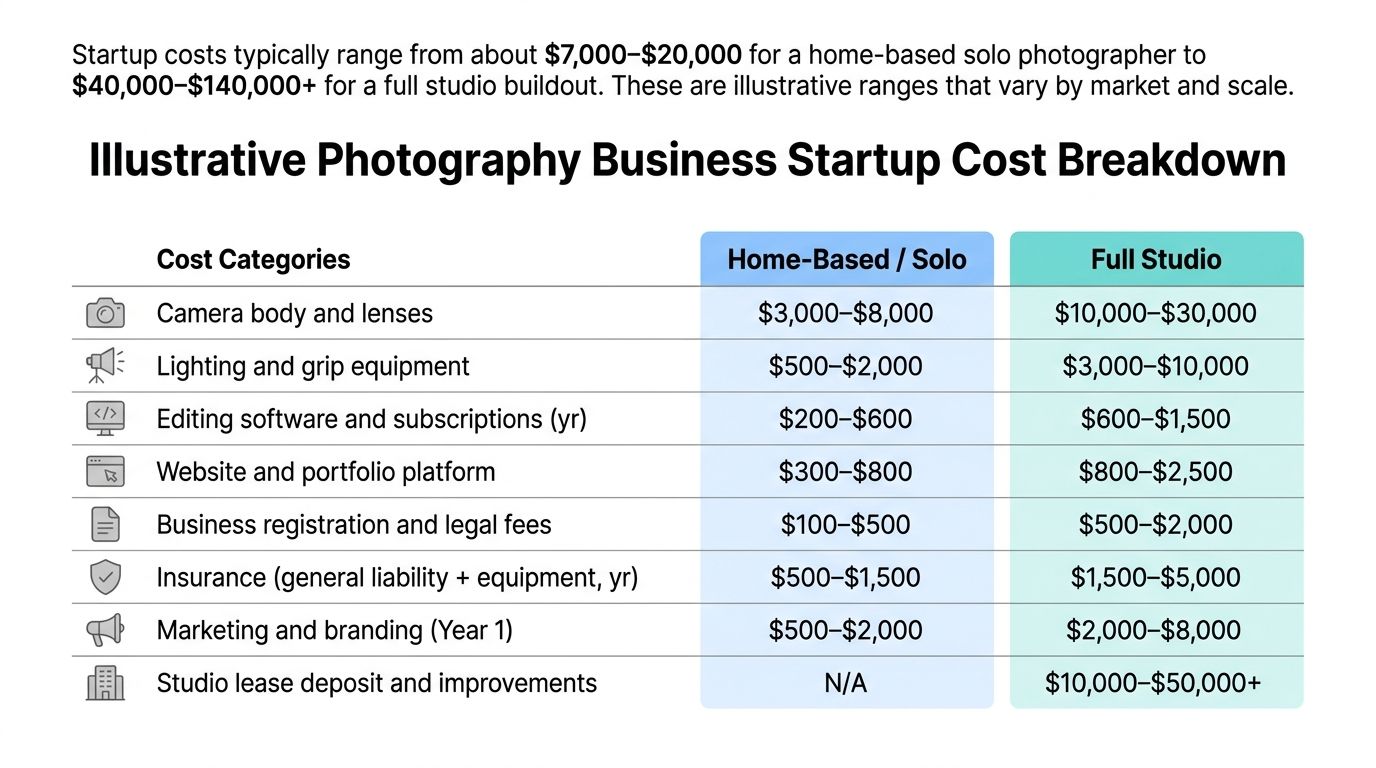
How much does it cost to start a photography business? Startup costs typically range from about $7,000–$20,000 for a home-based solo photographer to $40,000–$140,000+ for a full studio buildout. The range depends on equipment choices, location, and whether you're leasing commercial space. These are illustrative ranges that vary by market and scale.
Let's break down the actual costs.
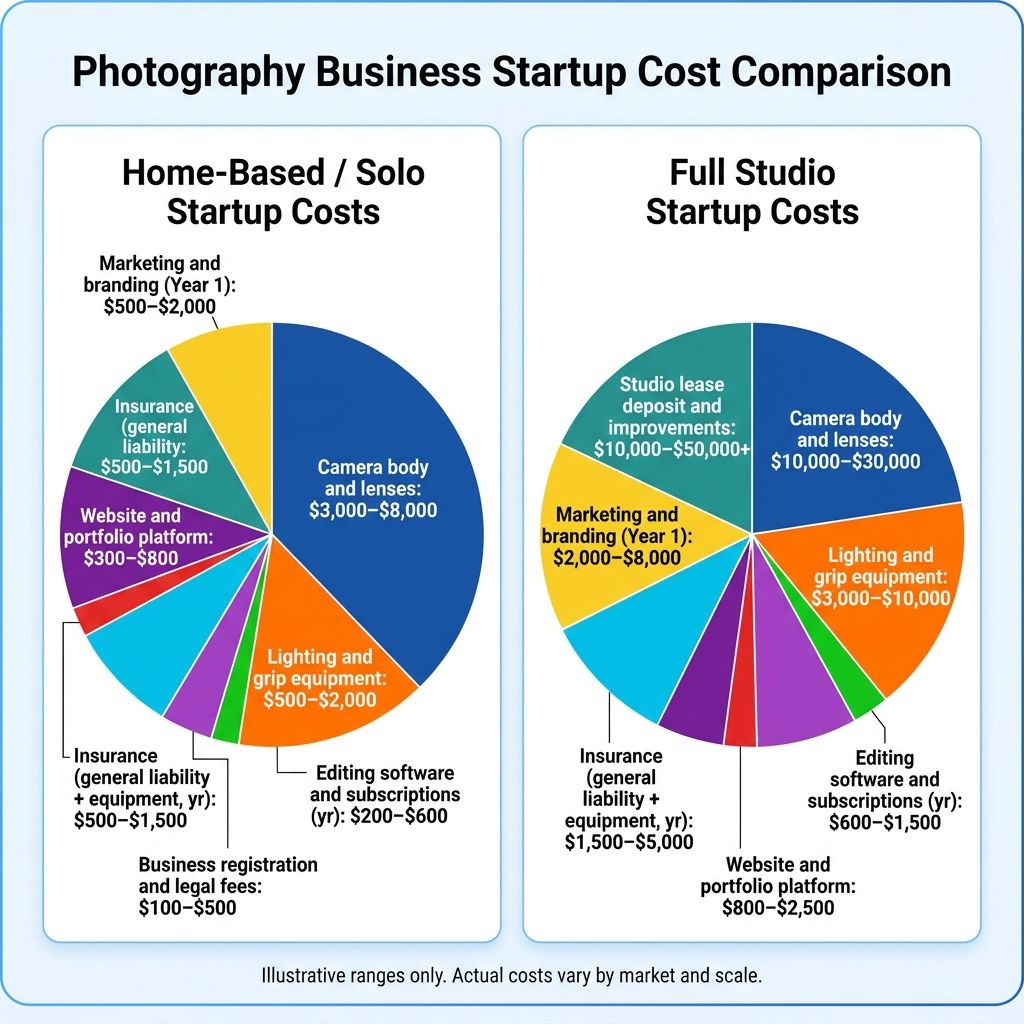
Illustrative Photography Business Startup Cost Breakdown
| Cost Category | Home-Based / Solo | Full Studio |
|---|---|---|
| Camera body and lenses | $3,000–$8,000 | $10,000–$30,000 |
| Lighting and grip equipment | $500–$2,000 | $3,000–$10,000 |
| Editing software and subscriptions (yr) | $200–$600 | $600–$1,500 |
| Website and portfolio platform | $300–$800 | $800–$2,500 |
| Business registration and legal fees | $100–$500 | $500–$2,000 |
| Insurance (general liability + equipment, yr) | $500–$1,500 | $1,500–$5,000 |
| Marketing and branding (Year 1) | $500–$2,000 | $2,000–$8,000 |
| Studio lease deposit and improvements | N/A | $10,000–$50,000+ |
| Working capital reserve | $2,000–$5,000 | $10,000–$30,000 |
| TOTAL RANGE | $7,100–$20,400 | $38,400–$139,000+ |
All figures above are illustrative ranges. Actual costs vary by location, vendor, and business scale. For equipment reference specs, sites like DPReview publish independent camera and lens reviews with current pricing.
Illustrative 3-Year Revenue Projection (Solo Wedding + Portrait Studio)
| Metric | Year 1 | Year 2 | Year 3 |
|---|---|---|---|
| Total Revenue | $60,000–$100,000 | $90,000–$150,000 | $120,000–$200,000 |
| Cost of Goods Sold | $15,000–$25,000 | $22,000–$37,000 | $28,000–$48,000 |
| Gross Profit | $45,000–$75,000 | $68,000–$113,000 | $92,000–$152,000 |
| Operating Expenses | $30,000–$55,000 | $35,000–$60,000 | $40,000–$70,000 |
| Net Profit | $15,000–$20,000 | $33,000–$53,000 | $52,000–$82,000 |
These are illustrative ranges only. Your actual results depend on your market, niche, pricing, volume, and overhead.
Warning: These Are Illustrative Ranges, Not Guarantees > > Every figure in this section is intended to show the structure of a financial projection, not to predict your results. This is not financial advice. Use SCORE's free templates or consult a CPA to build projections specific to your market and situation.
Tip: Break-Even Analysis > > Break-even = Fixed Costs ÷ (Average Revenue per Shoot − Variable Cost per Shoot). > > Example: If your fixed monthly costs (insurance, software, lease, phone) total $3,000, your average wedding brings in $3,000 revenue, and your variable costs per wedding (second shooter, travel, prints) total $600, your break-even is $3,000 ÷ ($3,000 − $600) = 1.25 weddings per month. You need at least 15 weddings per year just to cover your fixed overhead. Model your own numbers. Don't borrow these.
What Financial Documents Should Your Business Plan Include?
- Startup cost summary (one-time and first-year recurring expenses)
- 12-month cash flow forecast showing monthly income and expenses
- 3-year projected profit and loss statement
- Projected balance sheet at end of Years 1, 2, and 3
- Break-even analysis showing minimum monthly revenue needed
- Funding request (if applicable): total capital needed, proposed sources, intended use of funds
How to Write a Photography Business Funding Request
If you're going to a bank, the SBA, or an investor, this is the section they'll read twice.
- State the total capital required and the precise breakdown of how it will be used (equipment, marketing, working capital, lease deposit).
- Specify the funding structure: personal equity percentage vs. loan percentage.
- Reference available SBA loan programs for current program details.
- Include a repayment plan if seeking a loan: projected monthly payment, interest rate range, and term length.
- Lenders typically expect 2–3 years of financial projections alongside the funding request.
How to Price Your Photography Services
How to price photography services: Start with your Cost of Doing Business (CODB). CODB = (Annual Business Expenses + Desired Annual Salary) ÷ Number of Paid Shoots Per Year. This gives you a minimum revenue-per-shoot floor. Add a profit margin above that floor to set your actual price. Pricing anchored to CODB keeps you profitable. Pricing anchored to what your competitor charges on Instagram does not.
Example: The CODB Formula in Action > > Assume Aperture & Co. projects $40,000 in annual business expenses (insurance, software, marketing, gear replacement, studio costs) and wants a $60,000 owner salary. If they expect to shoot 40 weddings per year: > > CODB = ($40,000 + $60,000) ÷ 40 = $2,500 per wedding > > That's the floor. Pricing below $2,500 per wedding means Aperture & Co. loses money or works for free. Add a profit margin (say 20%) and your target average booking lands around $3,000. All figures illustrative.
Illustrative Photography Pricing Package Examples by Niche
| Niche | Entry Package | Mid-Tier Package | Premium Package |
|---|---|---|---|
| Wedding Photography | $1,500–$2,500 | $2,500–$4,500 | $5,000–$10,000+ |
| Portrait / Family | $100–$250 | $250–$500 | $600–$1,200 |
| Commercial / Brand | $400–$800/half day | $800–$1,800/full day | $2,000–$5,000+/day |
| Real Estate | $100–$200/property | $200–$400 | $400–$800+ |
| Product Photography | $50–$150/product | $150–$400 | $500+ |
Illustrative ranges only. Actual pricing varies significantly by geographic market, experience, and client segment. The PPA publishes annual benchmark surveys you can use as a sanity check.
Why CODB Beats Competitor-Based Pricing
- Matching competitor prices ignores your own cost structure and income needs.
- CODB ensures every shoot contributes to covering overhead, not just topping up revenue.
- Photographers who undercharge based on competitor rates commonly burn out or close within 2–3 years, a pattern widely reported in industry coverage at outlets like PetaPixel.
- Use PPA benchmark surveys as a sanity check after calculating CODB, not before.
How to Structure Photography Packages
- Offer three tiers (entry, mid-tier, premium) to serve different budget segments without devaluing your work.
- Anchor the mid-tier as your most profitable and most visible option. That's what most clients pick.
- Include clear deliverables per tier: coverage hours, edited image count, print credits, album options.
- Add-ons (extra hours, rush delivery, prints, albums) increase average order value without restructuring base packages.
SWOT Analysis for Photographers: Template With a Worked Example
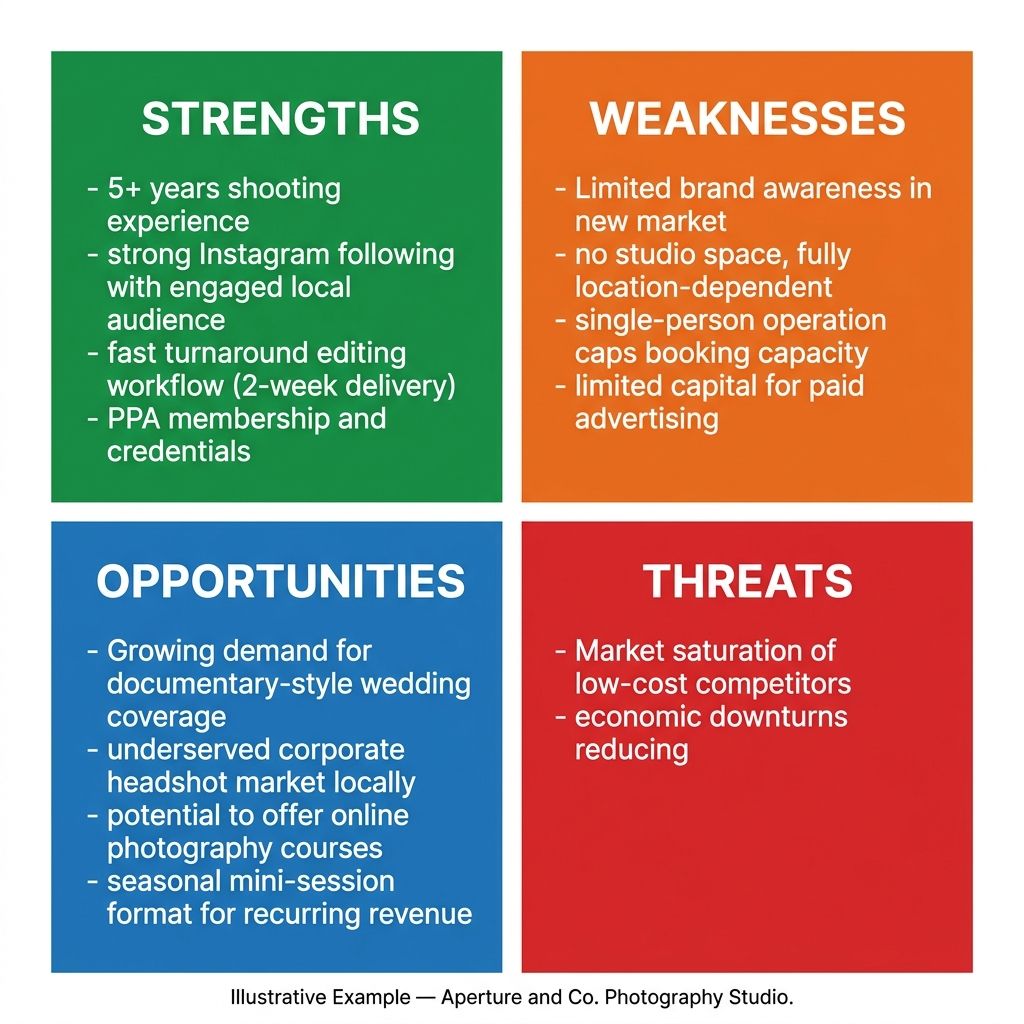
A SWOT analysis sits somewhere in your business overview or market analysis section. It's four quadrants: Strengths, Weaknesses, Opportunities, and Threats. Takes an hour to build. Saves you from strategy mistakes you'd only spot a year in.
SWOT Analysis Example: Solo Wedding and Portrait Photography Studio (Illustrative)
| Quadrant | Example Entries |
|---|---|
| Strengths | 5+ years shooting experience; strong Instagram following with engaged local audience; fast turnaround editing workflow (2-week delivery); PPA membership and credentials |
| Weaknesses | Limited brand awareness in new market; no studio space, fully location-dependent; single-person operation caps booking capacity; limited capital for paid advertising |
| Opportunities | Growing demand for documentary-style wedding coverage; underserved corporate headshot market locally; potential to offer online photography courses; seasonal mini-session format for recurring revenue |
| Threats | Market saturation of low-cost competitors; economic downturns reducing discretionary spending on photography; rapid smartphone camera improvements affecting entry-level portrait demand; seasonality risk in wedding market |
Illustrative example for Aperture & Co. Your SWOT will look different.
Tip: Use SWOT to Shape Your Marketing and Operations > > The SWOT isn't just lender-facing paperwork. Each weakness should map to a mitigation plan in your operations section. Each opportunity should drive a tactic in your marketing plan. Treat it as a living diagnostic, not a one-time exercise.
Photography Business Plan Variations by Niche
The core 8-section framework applies to every photography business. What shifts dramatically by niche: your services menu, pricing model, target customer, marketing channels, and seasonal cash flow. Here's what changes.
Key Business Plan Differences by Photography Niche
| Niche | Primary Revenue Model | Key Marketing Channel | Biggest Cost Driver | Peak Season |
|---|---|---|---|---|
| Wedding | Per-event flat fee | Instagram + venue referrals | Time per booking | Spring and fall |
| Portrait / Family | Session fee + prints/albums | Local SEO + Facebook | Marketing + mini-session labor | Holidays, back-to-school |
| Commercial / Brand | Day rates + licensing | LinkedIn, agency referrals, cold outreach | Equipment + post-production | Year-round, Q4 spike |
| Real Estate | Per-property, volume model | Realtor referrals + direct outreach | Fuel + scheduling overhead | Spring and summer |
| Product | Per-image or day rate | E-commerce platforms, agency referrals | Studio overhead + lighting | Q4 pre-holiday |
General patterns. Actual figures and timing vary by market.
Wedding Photography Business Plan
- Lead with seasonality in your financial projections. Most bookings cluster in spring and fall, so you need strong cash reserves for off-season months.
- Partnerships with venues, florists, and planners are your highest-ROI marketing channel. Document these relationships in your marketing and sales strategy section.
- Model second-shooter costs and a subcontractor agreement structure in your operations and staffing section.
- Contracts and deposit structures are critical. Reference your client agreement template in the appendix, and make sure your legal structure actually provides the protection you're relying on.
Portrait and Family Photography Business Plan
- Revenue typically combines session fees with print and album sales. Model both lines in your financial projections.
- Mini-session events (holiday, spring bluebonnets, fall foliage) deliver concentrated revenue bursts. Budget seasonal campaigns in your marketing plan.
- Local SEO (Google Business Profile, neighborhood Facebook groups, local parenting blogs) is a high-converting, low-cost channel for this niche.
- Studio overhead is the dominant cost driver when applicable. Model a home studio vs. leased studio scenario in your startup cost section so you can see the difference.
Commercial and Brand Photography Business Plan
- Your clients are businesses, not consumers. Shift your market analysis to describe your ideal business client by industry, company size, and marketing budget.
- Licensing and usage rights are revenue opportunities beyond the shoot fee. Build a licensing fee structure into your services section.
- Cold outreach, LinkedIn, and creative agency referrals are the primary channels. Document outreach cadence and weekly targets in your marketing plan.
- Day rates vary widely by market and deliverables. Reference PPA commercial survey data as a benchmark and calculate your own CODB floor.
Choosing a Legal Structure for Your Photography Business
Your legal structure determines personal liability exposure, tax treatment, and the paperwork you file every year. For most solo photographers, the real decision is sole proprietorship vs. single-member LLC. Higher earners eventually consider S-corp election.
Legal Structure Comparison for Photography Businesses
| Structure | Personal Liability Protection | Tax Treatment (IRS) | Typical Setup Cost | Best Fit For |
|---|---|---|---|---|
| Sole Proprietorship | None — personal assets at risk | Pass-through, reported on Schedule C | $0–$100 (DBA registration only) | Hobbyist transitioning to paid work, lowest-risk launches |
| Single-Member LLC | Yes — separates personal and business assets | Pass-through by default; can elect S-corp status | $50–$500 state filing fee | Most solo photographers wanting liability protection |
| Multi-Member LLC | Yes | Pass-through, partnership tax treatment by default | $100–$600+ state filing fees | Studios with multiple owners or partners |
| S-Corporation | Yes | Pass-through; salary + distributions split can reduce self-employment tax | $500–$2,000+ (legal + filing) | Higher-earning photographers ($80,000+ net) seeking payroll tax savings |
Tax implications vary by state and situation. See the IRS Business Structures guide for current federal treatment, and consult a licensed CPA before filing.
Warning: This Is Not Legal or Tax Advice > > The comparison above is general information only. Tax laws change and vary by state. Consult a licensed CPA or business attorney before choosing a legal structure. Check IRS.gov and your state's Secretary of State office for current filing requirements and fees.
Tip: Copyright Protection Starts the Moment You Click the Shutter > > In the US, your photographs are automatically protected by copyright from the moment of creation. Registering with the U.S. Copyright Office, however, lets you pursue statutory damages and attorney's fees in infringement cases, which changes the economics of enforcement entirely. See the U.S. Copyright Office FAQ for the registration process.
Common Photography Business Plan Mistakes to Avoid
Most rejected business plans fail for the same handful of reasons. Here are the six that come up most often:
- Vague executive summary with no numbers or ask
- Unrealistic financial projections with no documented assumptions
- Skipping the market analysis or writing "everyone needs photos"
- Pricing based on competitors instead of CODB
- Treating the plan as a one-time document
- Omitting legal and insurance details
Example: Weak vs. Strong Executive Summary > > Weak: "I am a passionate photographer who loves capturing memories. I want to start a business doing weddings and portraits because I've always dreamed of being my own boss." > > Strong: "Aperture & Co. is a sole-proprietor wedding and portrait studio targeting mid-market couples in the Austin metro area. Year 1 revenue is projected at $80,000–$120,000 (illustrative), funded by $25,000 in personal savings and a planned $20,000 SBA microloan. The studio differentiates on 2-week editing turnaround and documentary-style coverage."
Mistake 1: Writing a Vague Executive Summary
- First-time writers open with a passion statement instead of a business case.
- Lenders want numbers, market positioning, and a clear ask inside the first paragraph.
- Fix: State your niche, target market, revenue model, and funding need in the first three sentences.
Mistake 2: Ignoring Financials or Using Unrealistic Numbers
- Projecting 300 wedding bookings in Year 1 is a red flag for any lender. It signals you don't understand your market.
- Projections must be grounded in documented assumptions: addressable market size, inquiry volume, conversion rate, average booking value.
- Fix: Show your math. Write out each assumption ("we assume a 10% conversion rate on 50 monthly inquiries") and label every output as an estimate.
Mistake 3: Skipping the Market Analysis
- "Everyone needs photos" is not a market analysis. It's a reason lenders reject applications.
- Fix: Identify a specific target customer segment, size the addressable market using a cited industry report, and profile 3–5 real local competitors by name.
Mistake 4: Pricing Based on Competitors Instead of CODB
- Matching the cheapest competitor's price without calculating your costs is a path to working below minimum wage.
- Fix: Calculate your CODB first, set a price floor, and then decide where you want to position above that floor.
Mistake 5: Treating the Plan as a One-Time Document
- A plan written at launch and never revisited becomes obsolete within months as pricing, services, and market conditions shift.
- Fix: Schedule a 30-minute quarterly review to update actuals vs. projections, plus an annual full revision of all sections.
Mistake 6: Omitting Legal and Insurance Details
- Many photographers launch without documenting legal structure, contracts, or insurance.
- This matters for lenders, and even more for your own risk management.
- Fix: Include your legal structure with rationale, insurance coverage types, and a note on your standard client contract in the operations section.
Free Photography Business Plan Templates and Downloads
You don't have to build any of this from a blank page.
What's in the Photography Launchpad free template pack. The Word and Excel files also open in Google Docs and Google Sheets (upload to Google Drive, then Open with).
- 8-section business plan template: Word (.docx) or PDF
- Financials workbook: Excel (.xlsx), with three linked tabs:
- Startup Costs: editable cost rows that skip gear you already own, plus a 10% contingency
- 3-Year Projection: revenue, expenses, profit and cumulative cash with built-in formulas
- CODB Pricing: your break-even and recommended price per session from your costs and target salary
- SWOT analysis table: included in section 4 of the plan template
Tip: Also Recommended — SCORE and SBA Free Resources > > SCORE offers free business plan templates and free one-on-one mentoring from retired business executives. The SBA provides step-by-step guidance and connects you with local Small Business Development Centers (SBDCs), which offer free business plan reviews. Both are worth using before you submit a loan application.
Frequently Asked Questions About Photography Business Plans
Do I need a business plan to start a photography business?
You're not legally required to have one, but it's strongly recommended. A plan forces you to validate your pricing, estimate startup costs, and define your target market before you spend money. It's also required by most lenders and the SBA if you're seeking a loan.
How long should a photography business plan be?
A complete plan is typically 10–20 pages, excluding appendices. For a solo photographer, a focused 8–12 page plan is sufficient. Studio owners seeking significant funding should aim for 15–25 pages to include full financial projections and detailed market analysis.
How much does it cost to start a photography business?
Startup costs typically range from about $7,000–$20,000 for a home-based solo photographer to $40,000–$140,000+ for a full studio buildout, depending on equipment, location, and marketing. These are illustrative ranges. Actual costs vary significantly by market and business model.
What financial projections should a photography business plan include?
At minimum, include a startup cost breakdown, a 12-month cash flow forecast, a 3-year profit and loss projection, and a break-even analysis. If you're seeking a loan, add a funding request with a repayment plan. SCORE and the SBA offer free templates to help build these.
What legal structure is best for a photography business?
Most solo photographers start as sole proprietors for simplicity, then transition to a single-member LLC as revenue grows to gain personal liability protection. Higher earners may benefit from S-corp status for payroll tax savings. Consult a CPA or business attorney for advice specific to your situation and state.
What are common mistakes to avoid when writing a photography business plan?
The most common mistakes include writing a vague executive summary with no numbers, using unrealistic financial projections, skipping the market analysis, pricing based on competitors instead of your own costs, and treating the plan as a one-time document rather than updating it regularly.
How can a photography business plan help secure funding?
Lenders and investors use your plan to assess risk. A plan with detailed market research, documented assumptions, 3-year financial projections, and a clear funding request signals that you understand your business and have a realistic path to repayment. The SBA requires a business plan for most loan programs.
How often should I update my photography business plan?
Review your plan quarterly to compare actuals against projections and update assumptions as needed. Conduct a full annual revision covering all sections, especially financial projections, market conditions, and service offerings. Update immediately if you change legal structure, add a new niche, or seek new funding.
Sources
- Write Your Business Plan — U.S. Small Business Administration
- Business Employment Dynamics — U.S. Bureau of Labor Statistics
- Business Structures — IRS
- Business Resources — Professional Photographers of America (PPA)
- Business Plan Template for a Startup Business — SCORE
- Photography Industry in the US — IBISWorld
- Digital Photography Review (DPReview)
- Photography Business — PetaPixel
- Copyright FAQ — U.S. Copyright Office
- Photography Business Insurance — Insureon