
What is a photography contract, and what should every photographer include in one?
Quick answer: A photography contract is a legally binding written agreement between a photographer and a client that defines the scope of services, session date and location, payment and deposit terms, image deliverables, copyright ownership, model release permissions, and cancellation or rescheduling policies. Having a signed contract before every shoot protects both parties, prevents misunderstandings, and gives each side clear recourse if something goes wrong. The templates on this page are free to download in PDF, Word, or Google Docs format and cover the most common shoot types, including weddings, portraits, and commercial projects.
Download a free photography contract template in PDF, Word, and Google Docs. Includes wedding, portrait, and commercial versions plus a clause-by-clause guide.
Key Takeaways
- A photography contract should be signed before any deposit is collected or shoot date is confirmed.
- Essential clauses include scope of services, payment schedule, copyright, model release, and cancellation terms.
- A non-refundable retainer of 25–50% is standard practice to hold a date, per industry benchmarks.
- Under U.S. law, the photographer typically owns the copyright unless a written work-for-hire agreement transfers it.
- Electronic signatures are legally valid in the U.S. under the ESIGN Act and UETA.
- Niche shoots (boudoir, real estate, newborn) require additional or modified clauses not found in generic templates.
- Always have a licensed attorney in your jurisdiction review any contract before regular use.
Updated November 2026
What Is a Photography Contract?
A photography contract is a written, signed agreement between a photographer and a client that spells out what will be shot, when, for how much, who owns the resulting images, and what happens if things go sideways. It turns a verbal promise into an enforceable record. Both sides walk in knowing exactly what they're getting, and both sides have something to point to if a dispute pops up later.
Here's the reality: I've shot weddings where the timeline shifted three times, commercial gigs where the client suddenly wanted billboard rights they hadn't paid for, and portrait sessions where a parent demanded a refund the morning of. Every single one of those situations resolved cleanly because a signed contract said exactly what we'd agreed to. The shoots where I cut corners? Those are the ones that cost me money.

💡 Tip — Not Just for Weddings > Photography contracts aren't just for big-ticket weddings. Portrait sessions, brand shoots, real estate walkthroughs, newborn mini-sessions, and even free "TFP" collaborations should all be covered by a written agreement. If money or image rights are changing hands, you need it in writing.
⚠️ Legal Disclaimer > The templates and guidance on this page are general-purpose starting points. Contract law varies by state and country. Have any contract reviewed by a licensed attorney in your jurisdiction before you use it regularly with paying clients.
Why Every Photographer Needs One
- Prevents disputes over deliverables, timelines, and usage rights by putting every expectation in writing.
- Protects your deposit or retainer if a client cancels the day before the shoot.
- Establishes independent contractor status, which matters for tax and liability reasons. The IRS guidance on independent contractor classification lays out the factors that determine whether you're a contractor or an employee.
- Gives clients confidence they're hiring a professional who runs a real business, not a hobbyist.
- Creates a legal paper trail both parties can reference if a disagreement turns into a lawsuit or chargeback.
Download Your Free Photography Contract Template

Grab the template in whichever format works for you. PDF for read-only sending, Word for offline editing, Google Docs for cloud-based collaboration. Every version includes the same clause structure you'll see broken down below.
Available Photography Contract Templates
| Template Type | Best For | Formats Available |
|---|---|---|
| General Photography Services | Any paid shoot not covered by a niche template | PDF / Word / Google Docs |
| Wedding Photography | Full-day wedding coverage with second shooters | PDF / Word / Google Docs |
| Portrait Photography | Family, senior, headshot, and lifestyle portraits | PDF / Word / Google Docs |
| Commercial Photography | Brand, product, advertising, and editorial work | PDF / Word / Google Docs |
| Real Estate Photography | MLS listings, virtual tours, property marketing | PDF / Word / Google Docs |
| Newborn / Baby Photography | In-studio or in-home newborn sessions | PDF / Word / Google Docs |
| Boudoir Photography | Intimate portraiture requiring strict privacy terms | PDF / Word / Google Docs |
| Event Photography | Corporate events, parties, conferences, sports | PDF / Word / Google Docs |
💡 Tip — Online Fill Option > You can also fill out and customize the template directly in your browser, then send and sign contracts online without printing anything. Electronic signatures are legally valid in the U.S. under the federal ESIGN Act and the state-level Uniform Electronic Transactions Act (UETA), which has been adopted in nearly every state.
Which Template Format Should You Use?
- PDF: Best for sending a finalized, read-only version to clients for review or printing. Locks in the wording so nothing gets accidentally edited.
- Word (.docx): Best for editing and customizing clauses before sending. Most widely compatible across devices and easy for an attorney to redline.
- Google Docs: Best for cloud-based collaboration. Click "Make a Copy" to get your own editable version in your Drive.
- Online/fillable: Best if you want to complete the standard fields fast without touching the full document.
Key Clauses to Include in a Photography Contract
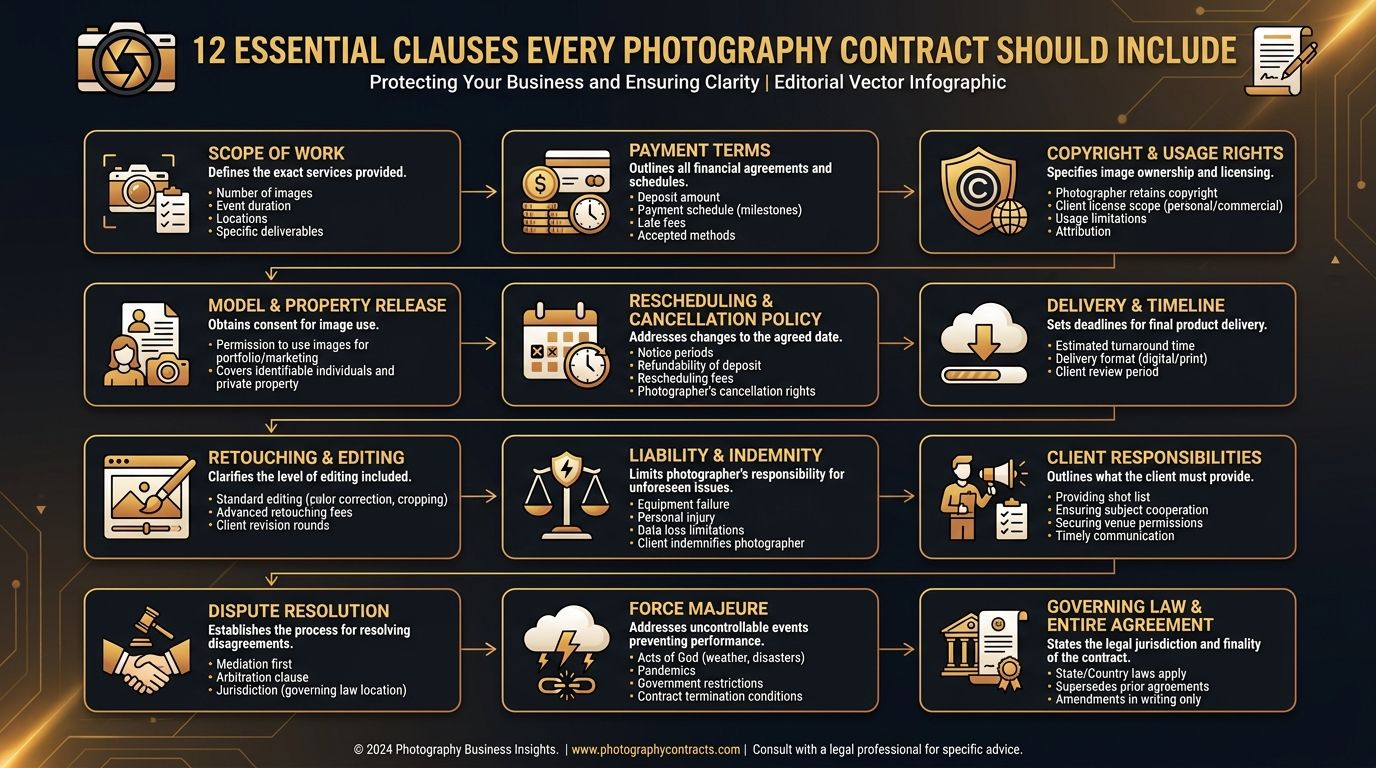
If you want to actually protect yourself, every photography contract needs the same core set of clauses. Here are the 12 you should never ship without:
- Parties and contact information
- Scope of services (event type, date, time, location)
- Deliverables and turnaround time
- Payment schedule and deposit/retainer amount
- Late payment fees
- Cancellation and rescheduling policy
- Copyright and image ownership
- Client usage and licensing rights
- Model release / portfolio usage
- Liability cap and indemnification
- Force majeure / Acts of God
- Independent contractor status, governing law, and signatures
Photography Contract Clause Checklist
- Parties and contact information
- Scope of services (event type, date, time, location)
- Deliverables and turnaround time
- Payment schedule and deposit/retainer amount
- Late payment fees
- Cancellation and rescheduling policy
- Copyright and image ownership
- Client usage and licensing rights
- Model release / portfolio usage
- Liability cap and indemnification
- Force majeure / Acts of God
- Independent contractor status
- Governing law and dispute resolution
- Signatures (electronic or ink)
📌 Example — Copyright Default Under U.S. Law > Under U.S. copyright law, the photographer who creates the image automatically owns the copyright unless a written work-for-hire agreement explicitly transfers ownership to the client. The U.S. Copyright Office confirms this default. Clients receive a usage license — not ownership — unless the contract says otherwise in writing.
💡 Tip — Force Majeure Matters > A force majeure clause protects both parties if a shoot gets cancelled by something neither side can control (natural disaster, serious illness, government restriction, venue closure). After the events of 2020–2021, almost every client asks about this clause now. Don't leave it out.
Scope of Services
- Specify the exact event type, date(s), start time, end time, and every location involved.
- List all deliverables: number of edited digital images, albums, prints, raw files (if any), or video highlights.
- Define the post-processing style expected — light color correction, full retouching, skin smoothing, or signature color grading.
- State the delivery method (online gallery, USB drive, cloud download link) and turnaround time in days or weeks.
The vaguer your scope, the more arguments you'll have. "I'll deliver some photos in a few weeks" turns into "where are my 500 images, I expected them last Friday." Spell it out.
Payment, Deposit, and Late Fees
- State the total contract price and the retainer/deposit amount required to secure the date.
- A non-refundable retainer typically runs 25%–50% of the total fee. WeddingWire and The Knot both report this range as standard for wedding photography.
- Specify the due date for the remaining balance — most photographers require it 7–14 days before the shoot.
- List accepted payment methods (bank transfer, credit card, Stripe, PayPal) and who eats processing fees.
- Define the late payment fee. A flat $50 fee or 1.5% per week overdue is common.
Copyright, Licensing, and Model Release
- State plainly that the photographer retains copyright ownership of all images created under the contract.
- Define the license granted to the client: personal use only, commercial use, social media only, print rights, duration of the license, and any geographic restrictions.
- For commercial clients who genuinely need full ownership, use an explicit work-for-hire clause — and price it higher, because you're selling the asset, not just the service.
- Model release clause: clearly grant or deny the photographer permission to use images in their portfolio, website, social media, and marketing materials.
- Minors require a parent or guardian signature on any model release. If you shoot kids, you need a separate model release form alongside your contract.
Cancellation, Rescheduling, and Force Majeure
- Define the cancellation window and whether the retainer is refundable. Most contracts make the retainer non-refundable across the board.
- Specify the rescheduling policy: how much advance notice is required, and how many reschedules are allowed before fees kick in.
- Include a force majeure clause covering severe weather, serious illness, venue closure, and government orders.
- State what happens if you (the photographer) can't perform due to illness or emergency: refund policy, backup photographer arrangement, or both.
Photography Contract Templates by Shoot Type
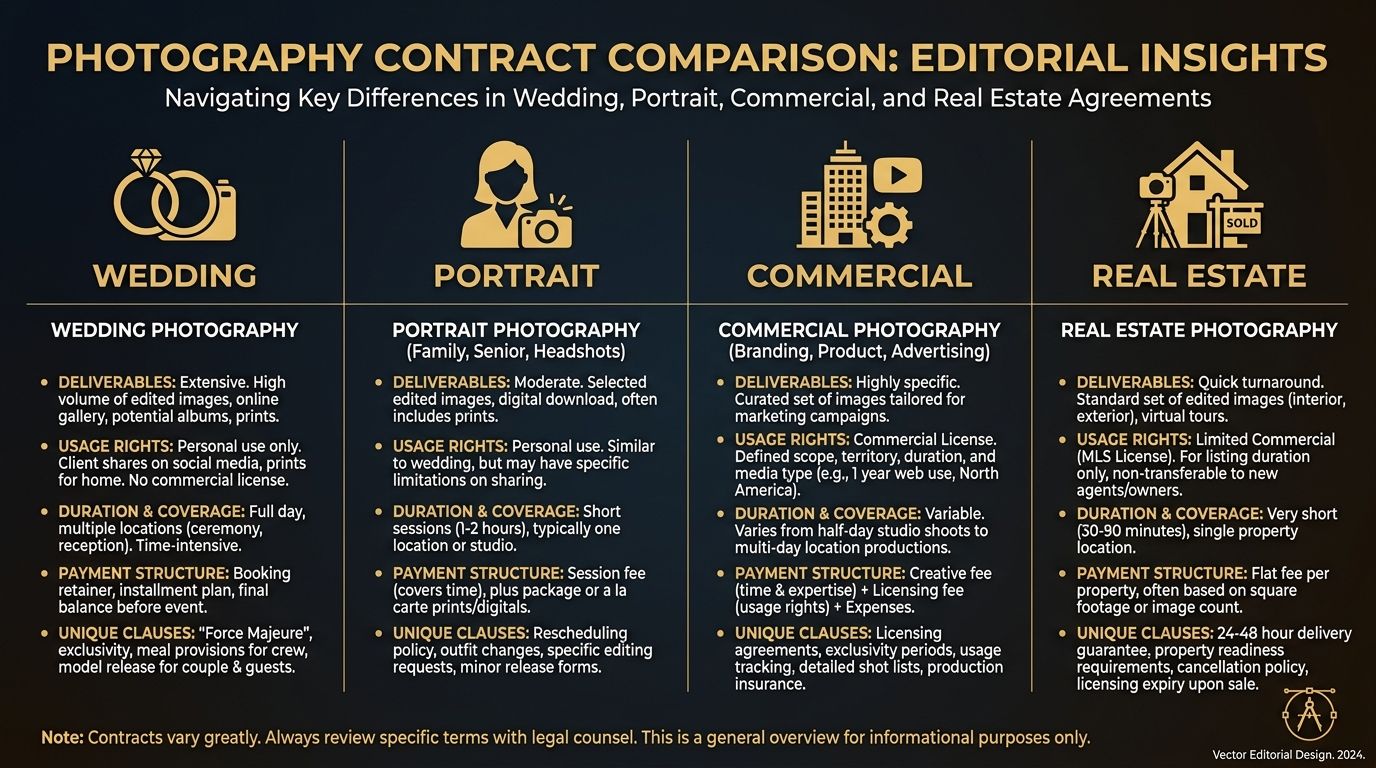
Not every shoot needs the same contract. A real estate photographer cranking out 24-hour turnarounds has different concerns than a boudoir photographer who must protect a client's privacy for the next decade.
Photography Contract Types: Key Differences
| Shoot Type | Unique Clauses Needed | Typical Client Type |
|---|---|---|
| Wedding | Second-shooter clause, venue access, album design timeline, date-change policy | Engaged couples, wedding planners |
| Portrait | Mini-session terms, wardrobe note, location selection, family/group composition | Families, individuals, seniors |
| Commercial | Work-for-hire option, brand usage rights, exclusivity period, media channels | Brands, agencies, marketing teams |
| Real Estate | MLS usage rights, 24–48 hour turnaround SLA, virtual tour license, post-sale rights | Realtors, brokerages, property managers |
| Newborn / Baby | Safety disclaimer, illness rescheduling, sibling/parent inclusion terms | New parents, families |
| Boudoir | Enhanced confidentiality, restricted sharing clause, granular model release, secure storage and deletion policy | Individual adult clients |
| Event | Multi-day coverage, guest management, equipment liability at venue | Corporations, nonprofits, organizers |
⚠️ Boudoir Contracts Need Extra Privacy Protection > Boudoir contracts must include a strict confidentiality clause preventing the photographer from sharing images publicly without explicit written consent, an enhanced model release with clear opt-in language (not opt-out), and a documented secure image storage and deletion policy. This is non-negotiable. One leaked boudoir image will end your business overnight.
Wedding Photography Contracts
- Include a second-shooter or associate photographer clause if you plan to bring assistance — clients should know who'll actually be at their wedding.
- Specify venue access requirements and restrictions (flash bans, restricted areas, ceremony noise policies).
- Define the album design and approval timeline separately from digital file delivery. These almost never run on the same schedule.
- Address what happens if the wedding date changes or the event is cancelled altogether.
For a clause-by-clause walkthrough specific to weddings, see the dedicated wedding photography contract template guide.
Commercial Photography Contracts
- Make the work-for-hire clause opt-in, not default. Commercial clients sometimes need full copyright transfer, but it should always be priced and agreed separately.
- Specify exclusivity terms: can you use the images in your portfolio? After what date? Within which industries?
- Define brand usage rights by channel (social, print, billboard, broadcast, paid digital) and duration (12 months, 3 years, perpetual).
- Add a credit/attribution clause if you want to be credited in published materials. Agencies will often agree if you ask upfront.
Real Estate Photography Contracts
- Grant MLS usage rights for the duration of the property listing, not in perpetuity.
- Define turnaround clearly. Real estate clients usually need images within 24–48 hours, and missing that window kills the listing.
- Spell out whether virtual tours, drone shots, or video walkthroughs are included or billed as add-ons.
- Address what happens to the images after the property sells: archived, deleted, or licensed for the agent's portfolio use.
How to Write a Photography Contract (Step by Step)
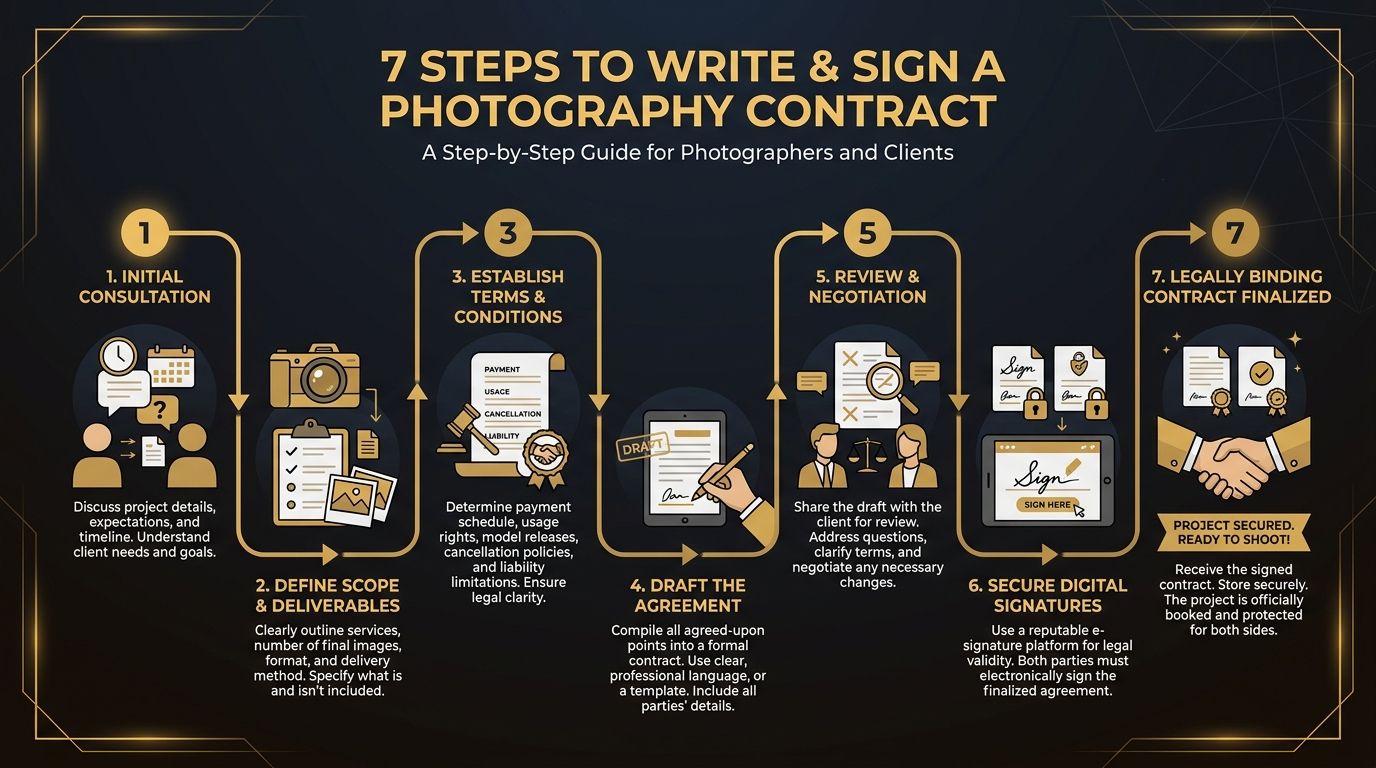
Here's the actual process, one step at a time:
- Identify Both Parties — Capture full legal names, business names, and contact info.
- Define Scope and Deliverables — Date, location, times, and a precise deliverables list.
- Set Payment Terms and Deposit — Total price, retainer amount, balance due date.
- Add Copyright and Usage Rights — Default ownership and the client's license.
- Include Model Release and Cancellation Terms — Portfolio use plus cancellation/force majeure.
- Have the Contract Reviewed — One-time attorney review if you shoot regularly.
- Send, Sign, and Store the Contract — E-signature, secure storage, and copies for both sides.
💡 Tip — Use a Template as Your Starting Point > You don't need to draft a contract from scratch. Download the template above, then customize each section for your specific shoot type, pricing, and local jurisdiction. Always save a master copy before editing client-specific versions, so you don't accidentally overwrite your base template.
💡 Tip — Electronic Signatures Are Legally Valid > Under the federal ESIGN Act and UETA, e-signatures carry the same legal weight as ink signatures across nearly every U.S. state. DocuSign, Adobe Sign, HoneyBook, Dubsado, and Pixieset Studio Manager all let you send and sign contracts online without printing anything.
Step 1: Identify Both Parties
- List the full legal name, business name (if any), address, phone, and email for both photographer and client.
- If you're shooting for a business, list the business's legal entity name (LLC, Inc.) and the name of the person signing on its behalf.
Step 2: Define the Scope of Services and Deliverables
- Describe the event or session type, the date, start and end times, and every location involved, including travel.
- List every deliverable in precise terms: number of edited images, file resolution, delivery format (JPEG, online gallery, USB), and a specific timeline like "within 4 weeks of the shoot date."
Step 3: Set Payment Terms and Deposit
- State the total contract value and the retainer amount (typically 25%–50%, non-refundable).
- Specify the payment schedule, accepted methods, and any late-payment fees in writing.
- If your client needs a separate invoice for accounting, a photography invoice template should accompany the contract.
Step 4: Add Copyright and Usage Rights
- Confirm that the photographer retains copyright unless a work-for-hire clause is specifically included.
- Grant the client a specific license — personal, commercial, for how long, and on which channels — in plain English the client can actually understand.
Step 5: Include Model Release and Cancellation Terms
- Specify whether you can use images in your portfolio and marketing, with the client's signed permission noted directly in the contract.
- Define cancellation, rescheduling, and force majeure terms clearly so no one is surprised.
- For shoots involving multiple subjects or minors, you'll need a standalone model release form on top of the contract.
Step 6: Have the Contract Reviewed (Recommended)
- If you shoot regularly or run high-value contracts (weddings, commercial), a one-time review by a licensed attorney in your state will save you money long-term. Expect to pay $200–$500 for an hour or two of review work.
- Contract law — especially liability caps, indemnification, and dispute resolution — varies by U.S. state and by country. A local attorney catches state-specific issues a template can't.
Step 7: Send, Sign, and Store the Contract
- Send the contract to the client before you collect any payment.
- Use an e-signature tool to collect a legally valid digital signature.
- Store signed copies in a secure cloud location (Google Drive, Dropbox, your CRM) and email the client a copy of the fully executed agreement.
- Never start shooting until the contract is signed AND the deposit has cleared. I've broken this rule twice. It cost me money both times.
Photography Pricing and Retainer Benchmarks
How much should you require as a deposit? Most professional photographers require a non-refundable retainer of 25%–50% of the total contract fee to hold a date, with the balance due before or on the shoot day. WeddingWire and The Knot both cite this range as the industry norm for wedding photography, and the same benchmark holds across portrait, commercial, and event work.
Typical Photography Pricing Ranges by Shoot Type (2026)
| Shoot Type | Typical Price Range | Common Retainer (25–50%) | Source |
|---|---|---|---|
| Wedding | $1,150–$3,000+ per event | $290–$1,500+ | WeddingWire, The Knot |
| Portrait / Headshot | $150–$500 per session | $40–$250 | Industry survey ranges |
| Commercial | Varies widely by usage and day rate | 25–50% of total | Negotiated per project |
| Real Estate | $100–$300 per property | $25–$150 | Regional MLS data |
| Newborn / Baby | $200–$500 per session | $50–$250 | Industry survey ranges |
| Event | Varies by duration and market | 25–50% of total | Negotiated per event |
Rates vary significantly by photographer experience, location, and local market. A wedding photographer in Manhattan charges several times what one in rural Oklahoma does for the same hours of coverage.
For a deeper look at building your own pricing structure, see the guide on how to price photography services.
📌 Example — Retainer vs. Deposit: What's the Difference? > A retainer is typically non-refundable and is earned by the photographer the moment the contract is signed — it compensates you for turning away other bookings on that date. A deposit may or may not be refundable depending on what the contract says. Use the term that matches your intent, and make the refund policy explicit. In some states, calling something a "deposit" when you actually mean a retainer can affect whether you can keep the money if the client cancels.
Photographer Pay: What the Data Shows
- The U.S. Bureau of Labor Statistics publishes annual median wage and employment data for photographers in its Occupational Outlook Handbook. Check the most current figures directly, since BLS updates them yearly.
- Self-employed photographers often earn well above or well below the median depending on specialty, geographic market, and how many years they've been building a client base.
- For working photographers, contract structure has a bigger effect on yearly income than gear or marketing spend. Tight payment terms and non-refundable retainers protect cash flow.
Common Photography Contract Mistakes to Avoid
The fastest way to get burned is to skip the boring parts. Here are the seven mistakes I see new photographers make over and over:
- Using a generic template without customizing it for the specific shoot type or your state.
- Failing to define deliverables precisely — vague language on image count, resolution, or delivery method causes disputes.
- Skipping a cancellation or rescheduling clause, which leaves you exposed if a client backs out last-minute.
- Omitting a force majeure clause, which became a brutal gap for many photographers during pandemic-era shutdowns.
- Using "deposit" when you mean a non-refundable retainer — the distinction has real legal consequences in some states.
- Starting work before the contract is signed and the deposit has cleared.
- Not specifying turnaround time for image delivery, which is the #1 source of client complaints.
⚠️ Verbal Agreements Are Not Enough > "We agreed on Instagram DMs" is not a contract. Verbal agreements and screenshot threads may not hold up in court, depending on your state's statute of frauds. A written, signed document is what you need. If a client refuses to sign, that's your signal to walk away.
Top Mistakes and How to Fix Them
Fix #1 is obvious: don't reuse a competitor's contract or a free template you found on Reddit without reading every line. Take the template above, sit down for an hour, and rewrite each clause in your own words to match your actual workflow.
Fix #2: replace every vague phrase. "Some edited images" becomes "75 fully edited high-resolution JPEG images." "Delivered soon" becomes "delivered via online gallery within 4 weeks of the shoot date."
Fix #3: write your cancellation policy as a specific schedule. Example — "Cancellation more than 90 days before the shoot: retainer forfeited. Cancellation within 30 days: 75% of total balance due. Cancellation within 7 days: 100% of total balance due."
Fix #4: add the force majeure clause now, before you need it.
Fix #5: use the word "retainer" anywhere you mean non-refundable, and state explicitly that it is non-refundable.
Fix #6: don't pick up the camera until both the signature and the payment have landed.
Fix #7: every contract should have a delivery deadline expressed in calendar weeks or a hard date.
Frequently Asked Questions
Do I legally need a photography contract?
No law requires a written photography contract, but it's strongly recommended for any paid shoot. A signed contract is the clearest way to prove agreed-upon terms if a dispute arises. Without one, you have almost no legal recourse if a client refuses to pay or disputes what they were supposed to get. Contract law varies by jurisdiction, so consult a local attorney for specific advice on your state.
What should a photography contract include?
A photography contract should include the names and contact details of both parties, the scope of services (event type, date, time, location), deliverables and turnaround time, payment schedule and deposit amount, cancellation and rescheduling policy, copyright and image ownership terms, the client's usage license, model release permissions, liability cap, force majeure clause, and signature lines for both parties.
How much of a deposit should a photographer require?
Most professional photographers require a non-refundable retainer of 25%–50% of the total contract fee to hold the date, with the balance due before or on the day of the shoot. The exact amount varies by photographer, shoot type, and market. Wedding photographers often require a higher retainer because blocking a Saturday means turning down other weddings. Always label it as a "retainer" if it's non-refundable.
Who owns the copyright to photos taken under a photography contract?
Under U.S. copyright law, the photographer who takes the images automatically owns the copyright unless the contract explicitly includes a work-for-hire clause that transfers ownership to the client. Clients typically receive a license to use the images (personal or commercial) rather than full copyright ownership. If a commercial client requires full ownership, it must be agreed upon in writing and is usually priced at a premium.
Can a photography contract be signed electronically?
Yes. Under the federal Electronic Signatures in Global and National Commerce Act (ESIGN Act) and the Uniform Electronic Transactions Act (UETA), adopted in nearly every U.S. state, electronic signatures are legally equivalent to ink signatures. Photographers can use tools like DocuSign, Adobe Sign, HoneyBook, Dubsado, or other photography CRM platforms to send contracts and collect e-signatures remotely.
What happens if a client cancels after signing the contract?
It depends on the cancellation clause in the signed contract. Most photography contracts state that the retainer is non-refundable if the client cancels, since it compensates the photographer for turning away other bookings for that date. Some contracts offer partial refunds on a sliding scale based on how far in advance the cancellation occurs. A clearly written cancellation clause prevents almost every cancellation dispute before it starts.
Is a free photography contract template legally valid?
A free template can form the basis of a legally valid contract if it's properly completed, signed by both parties, and contains the essential elements of a contract (offer, acceptance, consideration, and mutual intent). However, template language is general-purpose and may not account for the specific laws of your state or country. Have a licensed attorney in your jurisdiction review any template before you use it regularly with paying clients.
Do I need a separate contract for every client?
Yes. Each photography engagement should have its own signed contract with that client's specific details, session date, deliverables, and agreed price filled in. You can reuse the same master template across all clients of the same shoot type, but every contract must be individually completed and signed. Never reuse a signed contract from a previous client — it creates confusion over terms and isn't legally sound.
Sources
- Photographers — Occupational Outlook Handbook | U.S. Bureau of Labor Statistics
- Copyright in General | U.S. Copyright Office
- E-SIGN Act | Federal Trade Commission
- Independent Contractor Defined | IRS
- How Much Does a Wedding Photographer Cost? | WeddingWire
- Average Cost of a Wedding Photographer | The Knot
- Photography Business | PetaPixel
- Uniform Electronic Transactions Act (UETA) | Uniform Law Commission